



Blog
Formulation Analysis of 7-Day Paraffin Candles: Achieving a Precise 168-Hour Burn Time

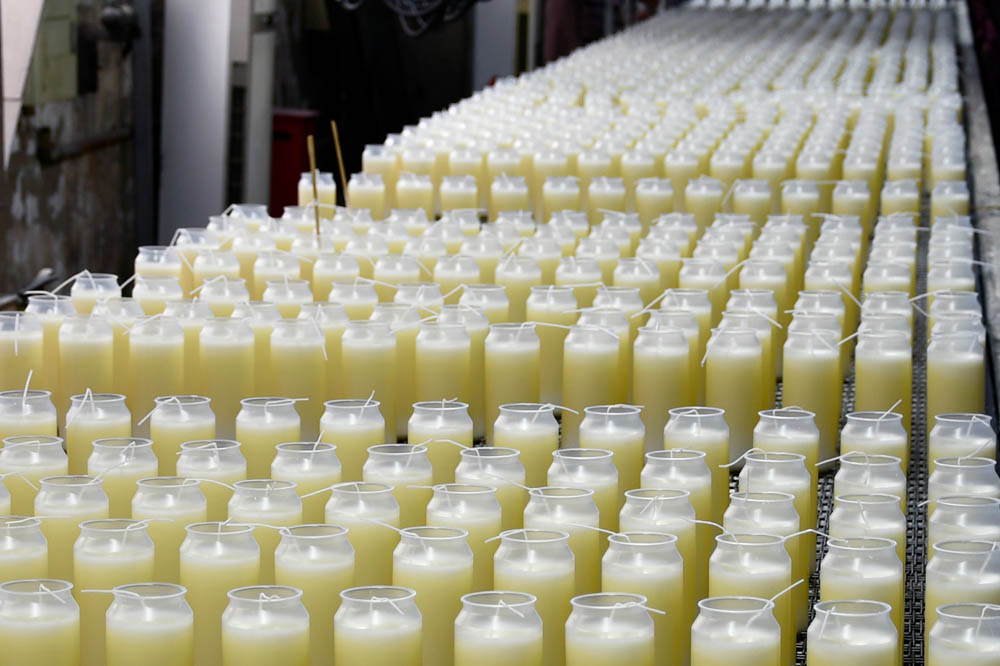
n the European religious, memorial, and home decor markets, candles capable of burning continuously for seven days (commonly referred to as “7-Day Sanctuary Candles” or “Weekly Candles”) command a massive and stable demand. Engineering a candle to burn for exactly 168 hours requires more than just precise wick matching—it relies heavily on the scientific formulation and ratio of the core fuel waxes.
1. Common Application Scenarios in the European Market
In Europe, 7-day candles are predominantly used in three high-frequency scenarios:
- Religious and Cemetery Memorials (Sanctuary & Cemetery): This represents the core market. European consumers traditionally light these candles at church altars or gravesides. Because cemeteries are often outdoors and not visited daily, a reliable 7-day burn time offers a lasting tribute to the departed.
- Religious Festivals and Rituals: During major traditional holidays such as Easter and All Saints’ Day, churches and households require continuous candlelight over extended periods without interruption.
- Emergency Lighting and Meditation: A growing segment of lifestyle-conscious consumers utilizes these candles for long-cycle indoor meditation or ambient lighting. They also serve as a staple for long-term household emergency lighting.
2. Comprehensive Comparison of Common Fuel Formulations
To achieve precise burn-time control while managing production costs, manufacturers blend fully refined paraffin wax, semi-refined paraffin wax, and mixed vegetable waxes in specific ratios. The table below provides a direct, multi-dimensional comparison of these three core formulations:
| Assessment Dimension | Formulation A: Fully Refined Paraffin-Based | Formulation B: Semi-Refined Paraffin-Based | Formulation C: Mixed Vegetable Wax (20%–50% Blend) |
|---|---|---|---|
| Core Characteristics | Extremely low oil content (<0.5%); high and stable melting point (58°C–60°C). | Moderate oil content (1.5%–2.0%); stable melting point (54°C–58°C). | Natural waxes (soy, coconut, or palm) blended into a paraffin base. |
| Burn Stability | Excellent. Delivers a clean flame with virtually zero soot or black smoke. | High. Requires precise wick calibration to prevent soot in later stages. | Variable. Highly susceptible to ambient temperature; prone to tunneling or extinguishing if mismanaged. |
| Environmental Resilience | Excellent. Highly resistant to softening or deformation during hot summer transit. | Good. May exhibit minor surface sweating or oil bleeding in extreme heat. | Weak. Prone to shrinking and cracking in winter or sweating in summer; demands strict container adhesion. |
| Burn-Time Control | Difficult. Tends to burn relatively fast; requires high-restriction wicks. | Easy. Minor natural oil content slows down vaporization, making rate control simple. | Moderate. Vegetable waxes naturally burn slower, but batch-to-batch variance requires frequent adjustments. |
| Raw Material Cost | High. Positioned at the premium end of petroleum-based waxes. | Low. The most cost-effective solution for mass industrial production. | Moderate to High. Subject to green premiums and price volatility in agricultural commodities. |
| European Consumer Appeal | Moderate. Standard synthetic perception. | Moderate. Standard synthetic perception. | Very High. Strongly aligns with European demands for low carbon emissions and sustainability. |
3. Market-Dominant Formulation and In-Depth Analysis
Currently, the most commercially successful and widely adopted formulation for 7-day candles in the European market is [Semi-Refined Paraffin Wax + 10%–20% Stearic Acid / Microcrystalline Wax]. This formulation dominates the market due to three critical factors:
① Cost-Efficiency: Overwhelming Price Advantage
7-Day candles are high-frequency consumables in Europe, making consumers highly price-sensitive. Semi-refined paraffin wax provides a very low raw material baseline cost. By introducing small amounts of stearic acid (to enhance hardness and whiteness) or microcrystalline wax, manufacturers can lock in the oil components while keeping total production costs at a minimum.
② Precise Time Control: The 1.9g/Hour Physical Equilibrium
The trace oil content inherently present in semi-refined paraffin wax naturally retards the vaporization process. When paired with a tightly braided cotton wick (such as those with a paper core or specialized tight-weave structures), the consumption rate can be perfectly restricted to 1.9 to 2.1 grams of wax per hour. Simple mathematics (hourly consumption × 168 hours) allows manufacturers to reliably hit the 7-day burning threshold.
③ Regulatory Compliance and Industry Standards
To be legally distributed and sold in Europe, these candles must strictly adhere to rigorous safety and emissions standards. This mainstream formulation makes it easiest to balance soot reduction and container heat resistance:
- European standards EN 15493 (Candles — Specification for Fire Safety) and EN 15426 (Candles — Specification for Sooting Behaviour) impose strict legal limits on flame height, secondary ignition tendencies, and carbon emissions.
- According to technical archives from the European Association of Candle Manufacturers (AECM) and the European Candle Quality Association (ECA)—which issues the widely recognized RAL-GZ 041 Quality Mark—the semi-refined paraffin and stearic acid blend ensures that the candle burns continuously for 168 hours with minimal residual wax and a sooting value well below the statutory EU ceiling. This guarantees the candle remains functional under both the blistering heat of southern European summers and the freezing winters of northern regions without cracking or detaching from its container.