


Blog
How to Choose and Use Easter Candles: A Complete Guide

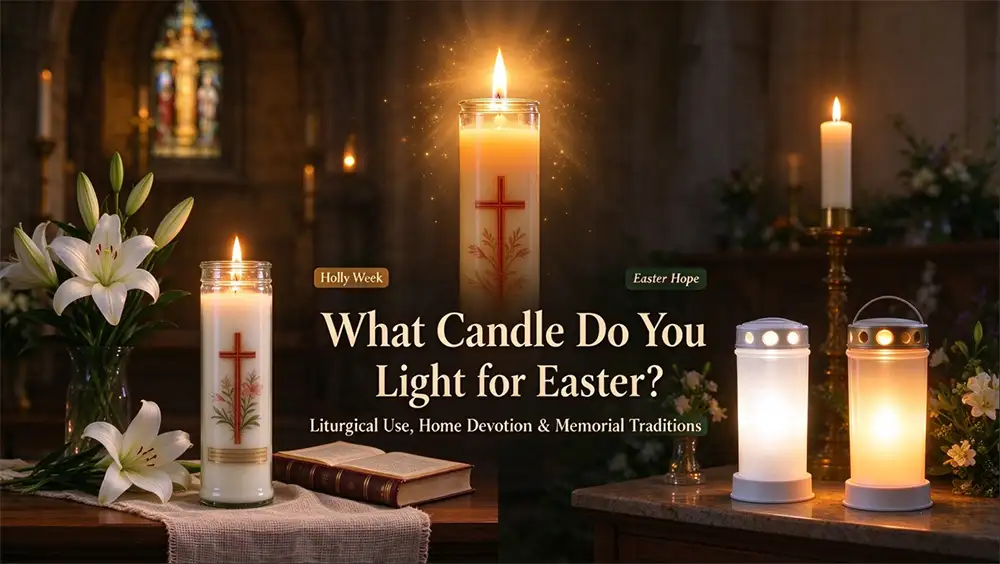
Why Easter Simply Isn’t Easter Without a Candle
On the Sunday following the first full moon after the spring equinox, many churches hold a service that begins in total darkness. A new fire is kindled outside, a tall candle is carried into the church, and its small flame is proclaimed in a clear voice: “The Light of Christ.”
This is the famous Paschal candle (also called the Easter candle), and the ritual behind it dates back to the 4th century — older than most holiday traditions we know today. But whether you’re decorating your home, serving in a church, or choosing a thoughtful gift, a practical question follows: which candle should you buy, and how should you use it?
This guide walks you through the three most common types — the traditional Paschal candle, the 7-day prayer candle, and the modern LED candle — with clear buying and safety advice for each.
The Paschal Candle: The Star of the Church
What It Is
The Paschal candle is the large ceremonial candle blessed during the Easter Vigil in Catholic, Anglican, and Lutheran traditions. It typically stands 80–120 cm (about 31–47 inches) tall and 8–10 cm (3–4 inches) thick. According to liturgical norms, it must be made of at least 51% beeswax (symbolizing Christ’s sinless humanity) and carries rich symbolism:
- A cross — the heart of the design
- Five grains of incense embedded in the cross — recalling the five wounds of Christ
- Alpha (Α) and Omega (Ω) above and below the cross — “the beginning and the end”
- The current year’s numerals between the letters — Christ belongs to all time
How It’s Used
- Lighting moment: At the start of the Easter Vigil, the candle is lit from the “new fire” and carried into the dark church while the congregation sings “The Light of Christ.”
- Burning period: It is lit at every service throughout Eastertide — the 50 days from Easter to Pentecost. Afterward it stands near the baptismal font or ambo and is lit only at baptisms (new life) and funerals (the hope of resurrection).
- Placement: During Eastertide it stands beside the altar or ambo. Older candles are traditionally stored with care or replaced each year.
Buying Tips
| What to Check | Recommendation |
|---|---|
| Material | For liturgical use, choose 51%+ beeswax; for home keepsakes, beeswax or soy wax burns cleaner with less soot |
| Size | Churches traditionally use 80–120 cm; home replica versions of 20–40 cm work well |
| Design | Look for the cross, Alpha/Omega, year numerals, and five incense pins — quality makers cast these in one pass |
| Wick | Choose lead-free cotton wicks for a steady flame and minimal smoke |
| Safety | Use a sturdy candle holder, and keep flammable items at least 30 cm (12 in) away |
The 7-Day Prayer Candle: A Week-Long Companion for Home Devotion
What It Is
A 7-day prayer candle is a pillar candle designed to burn continuously for about seven days (typically 110–170 hours). It’s common in Catholic and other traditional households. You’ll usually find it in two forms: a glass-encased candle (often printed with an image or prayer) and a plain tall pillar candle.
Unlike the Paschal candle, this is not a liturgical item. Think of it as a gentle timer for personal devotion: as long as the flame burns, it quietly reminds you to pause, pray, or read Scripture each day.
How It’s Used
- When to light it: During Easter week (or any week of Eastertide), paired with a short daily prayer or reading at a fixed time.
- Easter tradition: Many families light one on Easter Sunday — a symbol of keeping watch at the empty tomb — letting it last through the Easter Octave.
Safety note: Folk custom says a 7-day candle must burn uninterrupted, but that’s a tradition, not a doctrine. From a fire-safety standpoint, never leave it burning unattended — extinguish it before bed or when leaving home, then relight the next day.
Buying Tips
- Check the burn-time label. Reputable brands state the hours; glass-encased candles typically run 110–140 hours.
- Check the wax. Beeswax and soy burn cleaner; paraffin is cheaper but sootier. The wax surface should be smooth and bubble-free.
- Check the wick. It should be centered and anchored to the bottom — otherwise the candle “tunnels” sideways and half the wax goes to waste.
- Check the jar. Thick glass without cracks, with a mouth at least 6 cm (2.4 in) wide so the flame doesn’t hug the walls.
LED Candles: Do They Belong at Easter?
This is the question everyone asks now. The honest answer: it depends on the setting.
Where LED Candles Shine (Recommended)
- Homes with kids, seniors, or pets: No open flame, no hot wax drips, no smoke — perfect for Easter tables, windowsills, and floral arrangements.
- Fire-restricted venues: Schools, daycare centers, hospitals, nursing homes, and many rentals ban open flames; LED candles are the only compliant option.
- Outdoors or windy spots: Real flames die fast in the breeze; windproof LED candles keep glowing.
- All-week ambiance: Many models include timers (e.g., 5 hours on, 19 hours off), ideal for keeping the glow going all Easter week.
Where They Fall Short (Be Aware)
- Formal church liturgy: Liturgical norms in the Catholic Church and many others require real wax and a real flame — electronic candles cannot substitute for ceremonial candles. If fire codes prevent this, consult your pastor rather than swapping everything out on your own.
- Devotions centered on sacrifice: A real candle consumes itself — a symbolism many believers cherish. If that matters to you, a beeswax votive or 7-day candle is the better fit.
Buying & Usage Tips
- Choose a “flickering flame” style — it looks far more like real fire. Avoid cool-white LEDs; go for warm 1800–2200K light.
- Wax shells beat plastic. Real wax housing around the LED feels and looks authentic.
- Mind the power. Battery models vary in runtime; USB-rechargeable ones suit daily long burns.
- Outdoors: pick IP44 or higher waterproof ratings. Indoors, remote-and-timer sets are the most convenient.
Common Misconceptions, Cleared Up
- “A Paschal candle is just a big candle anyone can light for fun.” It’s a liturgical item with a specific consecrated purpose; for home use, choose a small keepsake replica instead.
- “A 7-day candle must burn for seven days straight, or it ‘doesn’t count.'” That’s folk custom, not doctrine. Extinguish it whenever no one is around — safety first.
- “LED candles in church are just as good.” Liturgically, no — the rites call for real wax and real flame. LEDs belong at home and in fire-restricted spaces.
- “Beeswax vs. paraffin is only about price.” Beeswax burns longer, cleaner, and with a natural honey scent, and it carries symbolic meaning in church tradition. Paraffin is petroleum-based and sootier, which matters most in large candles.
The Bottom Line: One Table to Choose Right
| Your Setting | Best Choice | Why |
|---|---|---|
| Church Easter liturgy | 51%+ beeswax Paschal candle | Meets liturgical norms; burns long and clean |
| Home devotion / Easter week | Glass-encased 7-day prayer candle | Controllable burn time; a week of quiet watchfulness |
| Family spaces with kids or pets | Warm-light flickering LED candle | No open flame; timer-friendly |
| Outdoors / fire-restricted venues | Windproof, waterproof LED candle | Compliant, weatherproof, zero maintenance |
In the end, the Easter candle has never really been about wax and fire — it’s about the image of a single light in the darkness. Whether you choose traditional beeswax or an LED alternative, put safety first, put heart into it second, and the sense of occasion will take care of itself.
Sources & Further Reading
- General Instruction of the Roman Missal (GIRM), provisions on the Paschal candle (nos. 309, 317)
- Easter Vigil guidelines issued by national bishops’ liturgical commissions
- Home fire-safety guidance on candle use from national fire departments
Disclaimer: This article is for general information about religious tradition and consumer products, not legal or doctrinal advice. Liturgical practices vary by denomination and parish — when in doubt, ask your local clergy.


