



Blog
Production Tips: Solve Common Defects of 7-Day Candles


A 7-day candle, also known as a 168-hour vigil candle or long-burning ritual candle, is a specialty wax product engineered for ultra-long, consistent combustion. Its manufacturing logic differs entirely from conventional lighting candles and scented candles. While ordinary candles prioritize high brightness and fast burning speeds, premium 7-day ritual candles adhere to three strict core standards: precise 168-hour burning duration, uninterrupted long-cycle combustion, and stable, clean burning performance.
Due to their large wax filling capacity and ultra-long continuous combustion design, 7-day candles are prone to four typical mass-production defects:wall clinging, wax dripping, mid-burn flame extinction, excessive black smoke, and container blackening. In most cases, these quality issues are not caused by defective raw paraffin wax, but by unstandardized production techniques, unstable temperature control, improper wick selection, and inconsistent cooling procedures.
Based on real-world factory production experience, this article comprehensively introduces the two mainstream manufacturing processes for 7-day candles, compares the pros and cons of manual and automatic assembly lines, and analyzes the root causes of common combustion defects with practical, factory-grade solutions for standardized mass production and quality optimization.
1. Mainstream Production Processes for 7-Day Candles: Cold Press Molding vs. Hot Pouring
Currently, industrial mass production of 7-day candles relies on two mature manufacturing processes. Each process greatly affects finished product stability, batch defect rate, and burning time accuracy, catering to different order scales and quality requirements.
1.1 Cold Press Molding (Mainstream for Small Factories & Small-Batch OEM Orders)
Process Principle: Raw paraffin wax is crushed into uniform granular particles, then tightly compacted and molded via high-pressure molds. After molding, candles are fitted with wicks and sealed into containers. The entire cold-forming process requires no high-temperature wax melting or liquid pouring.
Advantages: This process features fast production speed, zero melting equipment investment, low energy consumption, and low technical barriers. It is ideal for small-batch, urgent, and OEM customized orders. Since no high-temperature cooling shrinkage occurs, cold-pressed candles have smooth surfaces with minimal cosmetic defects.
Disadvantages (Critical Quality Limitations): Cold-compacted granular wax contains tiny internal gaps and uneven density with insufficient compaction tightness. During 168-hour long combustion, unstable wax capillary penetration frequently causes unexpected flame extinction, localized fast burning, and inaccurate burning duration. Additionally, loose wax structure leads to poor wick adhesion, resulting in wick displacement or detachment after long-term storage. This process is the primary reason for high defect rates in low-end 7-day candles and is not recommended for export-grade products.
1.2 Hot Pouring Process (Standard for Large Factories & Export Orders)
Process Principle: High-quality semi-refined paraffin wax and auxiliary additives are fully melted and homogenized at a constant temperature. The qualified liquid wax is precisely and evenly poured into containers via quantitative filling equipment, followed by constant-temperature natural cooling, secondary wax refilling to eliminate shrinkage gaps, and static curing. This is the only standardized manufacturing process for premium export-grade 7-day vigil candles.
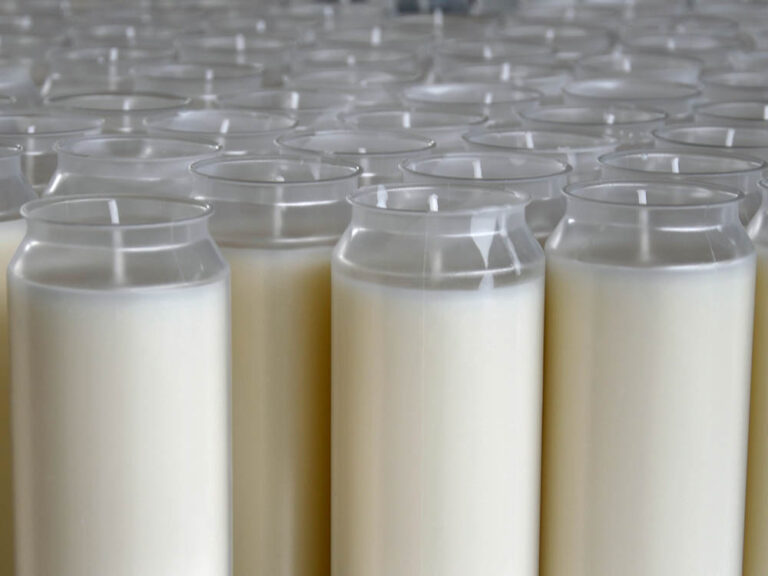
Advantages: Hot-poured wax boasts uniform density and zero internal gaps, ensuring perfect wick verticality and tight wax-wick integration. It delivers highly stable wax oil climbing, molten pool formation, and combustion speed, enabling precise 168-hour burning time control. The entire combustion cycle remains balanced and consistent with rare flame outage or uneven burning, ensuring reliable batch quality for large-volume full-container export orders.
Disadvantages: The hot-pouring workflow is elaborate and highly dependent on precise temperature control, stable filling speed, and dust-free constant-temperature cooling environments. Minor parameter fluctuations can cause batch-wide defects. It requires longer production cycles, higher energy consumption, professional production equipment, and experienced technical operators.
2. Mass Production Modes for 7-Day Candles: Manual Assembly Line vs. Automatic Assembly Line
Based on processing characteristics, industrial mass production of 7-day candles is divided into two mainstream modes: semi-automatic manual assembly lines and fully automatic digital assembly lines, each with distinct advantages and disadvantages for different order demands.
2.1 Semi-Automatic Manual Assembly Line (Mainstream for Medium and Small Factories)
Operation Mode: Machines complete unified wax melting and constant-temperature wax storage, while core procedures including wick positioning, container placement, auxiliary filling, and finished product quality inspection rely on manual operation and supervision.
Core Advantages: Extremely flexible for parameter adjustment, including filling weight and wick specification replacement, suitable for multi-style, small-batch customized orders. It features low equipment investment cost, fast mold switching, and flexible debugging, with real-time manual screening and repair of defective products.
Core Disadvantages: Poor batch consistency caused by manual operational errors. Inconsistent filling speed, container placement deviation, and workshop temperature fluctuations often lead to wick deflection and uneven wax filling. The same batch of products may show unstable combustion performance, resulting in higher defect rates and failure to meet unified quality standards for large full-container export orders.
2.2 Fully Automatic Mechanical Assembly Line (Standard Configuration for Large Export Factories)
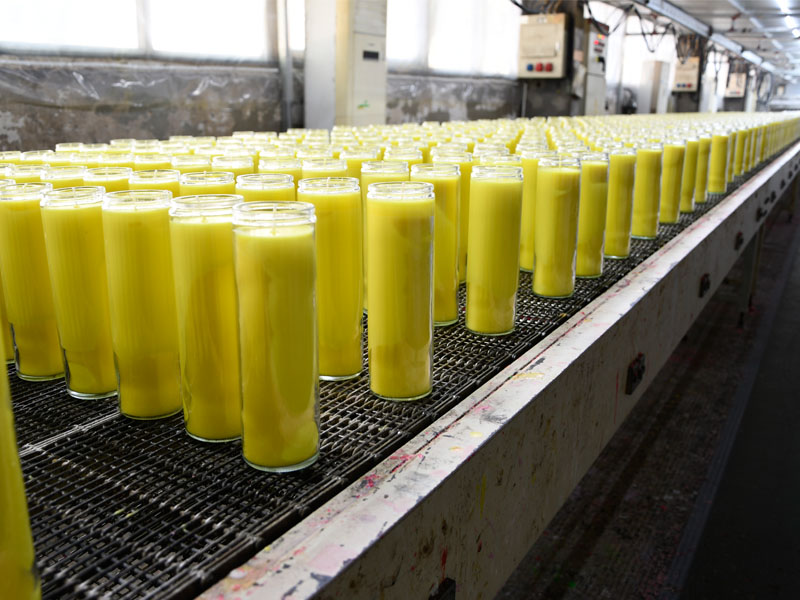
Operation Mode: Fully automatic integrated production equipment completes the entire manufacturing process, including automatic wick fixing, constant-temperature quantitative filling, uniform cooling, capping, coding, and quality inspection. All production parameters are digitally locked for zero deviation.
Core Advantages: All key production indicators, including filling weight, wick verticality, melting temperature, and cooling duration, are fully standardized. The burning time error within a single batch is controlled within 2 hours. Eliminating manual errors drastically reduces the batch occurrence of wax dripping, flame extinction, black smoke, and container carbon deposition defects, delivering ultra-stable quality for large-scale export shipments.
Core Disadvantages: High initial equipment investment and long commissioning and debugging cycles. Formula adjustment and product switching are time-consuming, making it incompatible with small-batch customized orders. Parameter setting errors will cause large-scale homogeneous batch defects with high troubleshooting and rework costs.
3. Four Common 7-Day Candle Defects: Root Causes & Professional Solutions
Nearly all combustion defects of 7-day candles originate from four controllable factors: unstable thermal control, mismatched candle wicks, non-standard cooling processes, and unreasonable wax formula proportioning. The following factory-level analysis elaborates on verified root causes and practical, implementable solutions for on-site quality control optimization.
3.1 Wall Clinging & Wax Dripping
Root Causes: Excessively high pouring temperature leads to rapid surface solidification and uneven internal cooling shrinkage, forming hidden gaps inside the wax body. Inclined or offset wicks produce biased flames that continuously bake the container wall. Strong airflow and drastic temperature differences in the workshop cause localized over-melting and wax flow.

Solutions: Lock the standard constant filling temperature for semi-refined paraffin at 160–165℉ to avoid overheating; cure finished products in a windless, constant-temperature environment and prohibit forced rapid cooling; calibrate wick verticality and central positioning for every product; adopt a professional secondary wax refilling process to compensate for cooling shrinkage gaps and eliminate wall clinging and dripping fundamentally.
3.2 Flame Extinction During Combustion (Most Critical Quality Defect)
Root Causes: Overly thin wicks accumulate carbon deposits during long-term combustion, blocking wax oil capillary climbing. Loose wax structure and internal gaps from cold pressing cause molten pool disconnection and fuel interruption. Excessive filling height results in ultra-thick top wax that cannot form an effective initial molten pool. Low paraffin oil content reduces wax fluidity, leading to insufficient fuel supply.
Solutions: Adopt dedicated medium-density stable wicks exclusively matched for 7-day long combustion, avoiding ultra-thin cost-saving wicks; apply hot-pouring technology to ensure compact, uniform wax density; unify standard filling height to reserve sufficient molten pool space; fine-tune paraffin oil content to optimize wax fluidity and sustain continuous fuel circulation.
3.3 Excessive Black Smoke & Turbid Flame
Root Causes: Overly thick wicks generate excessive flame power beyond the stable combustion load of 7-day ritual candles. Unfiltered wax impurities or recycled wax adulteration lead to incomplete combustion. Unstable airflow causes flame shaking and turbulent burning. Over-long, unfixed wick tops diverge and produce persistent black smoke.
Solutions: Equip products with exclusive fine stable wicks for precise flame control; implement multi-stage wax filtration to remove impurities and reject inferior recycled wax; maintain windless conditions during production, curing, and combustion testing to ensure vertical, stable flame burning; uniformly trim and shape wick length before packaging and delivery.
3.4 Container Blackening & Severe Wall Carbon Deposition
Root Causes: Overly high, unstable flames continuously radiate and bake the inner container wall. Impure wax materials and floating workshop dust form carbide precipitates during combustion. Unfixed, swinging or offset wicks cause unilateral high-temperature combustion and localized wall scorching. Dust contamination during uncured wax curing leads to residual carbon deposits.
Solutions: Stabilize micro-flame combustion and strictly control flame height; implement closed dust-free workshop production and multi-stage wax purification; fix wicks vertically at the exact center to avoid biased combustion; stabilize combustion temperature to prevent localized overheating and reduce carbide precipitation and container blackening.
4. 7-Day Candle Mass Production Defect Troubleshooting & Solution Table (Factory Directly Applicable)
| Common Defects | Core Production Causes | Standardized Solutions | Prevention & Control Key Points |
| Wall clinging & wax dripping | 1. Over-high filling temperature and uneven cooling shrinkage; 2. Inclined wick causing unilateral wall baking; 3. Windy workshop and rapid temperature cooling | 1. Lock constant filling temperature at 160–165℉; 2. Calibrate wick verticality consistently; 3. Cool finished products in windless & constant-temperature environment; 4. Adopt secondary wax refilling process | Solidify temperature parameters, prohibit high-temperature rapid cooling, and inspect wick position per batch |
| Mid-combustion flame extinction | 1. Over-thin wick with carbon blockage; 2. Loose wax density from cold press process; 3. Over-filling leading to ineffective molten pool; 4. Poor wax oil fluidity and insufficient fuel supply | 1. Replace with dedicated stable combustion wicks; 2. Adopt hot pouring process for uniform wax density; 3. Unify standard filling height; 4. Adjust paraffin oil content to improve fluidity | Ban cold press process for export orders; conduct 168-hour full-burning test per batch |
| Excessive black smoke & turbid flame | 1. Over-thick wick with excessive fire power; 2. Impure wax materials or recycled wax doping; 3. Wind disturbance causing incomplete combustion; 4. Untrimmed over-long wicks | 1. Match exclusive fine stable wicks for fire control; 2. Filter molten wax thoroughly to eliminate inferior materials; 3. Maintain windless production and testing environment; 4. Uniformly trim and shape wicks before delivery | Implement batch raw material inspection, standardize wick specifications, and control wind conditions during combustion testing |
| Container blackening & carbon deposition | 1. Over-high flame causing continuous wall baking; 2. Excessive wax impurities and dust precipitating carbides; 3. Offset wick and biased combustion; 4. Dust contamination during production | 1. Stabilize micro-fire combustion and control flame height; 2. Adopt dust-free closed production and multi-stage wax filtration; 3. Fix wicks vertically in the center; 4. Strictly control workshop sanitation to avoid dust falling | Keep production workshop closed and dust-free; observe container combustion status per batch and adjust wick specifications timely |
5. Conclusion: Core Mass Production Tips for Qualified 7-Day Candles
The core of 7-day candle quality control relies on standardized processes, fixed production parameters, and refined operational details rather than complex formula adjustments. Cold press molding is only suitable for low-end small-batch orders. Premium export-grade 7-day candles require a complete standardized production system: constant-temperature hot pouring, secondary wax refilling, professional wick matching, and windless constant-temperature curing. Most batch defects stem from unstandardized parameters and irregular operation. By solidifying full-process production specifications and strict quality prevention control, factories can effectively reduce defect rates and stably supply high-quality 7-day candles with accurate 168-hour duration, clean combustion, and zero cosmetic and functional defects.