



Blog
Why Are My Hanukkah Candles Dripping? The Real Factory-Level Answer (Not Just “Trim the Wick”)

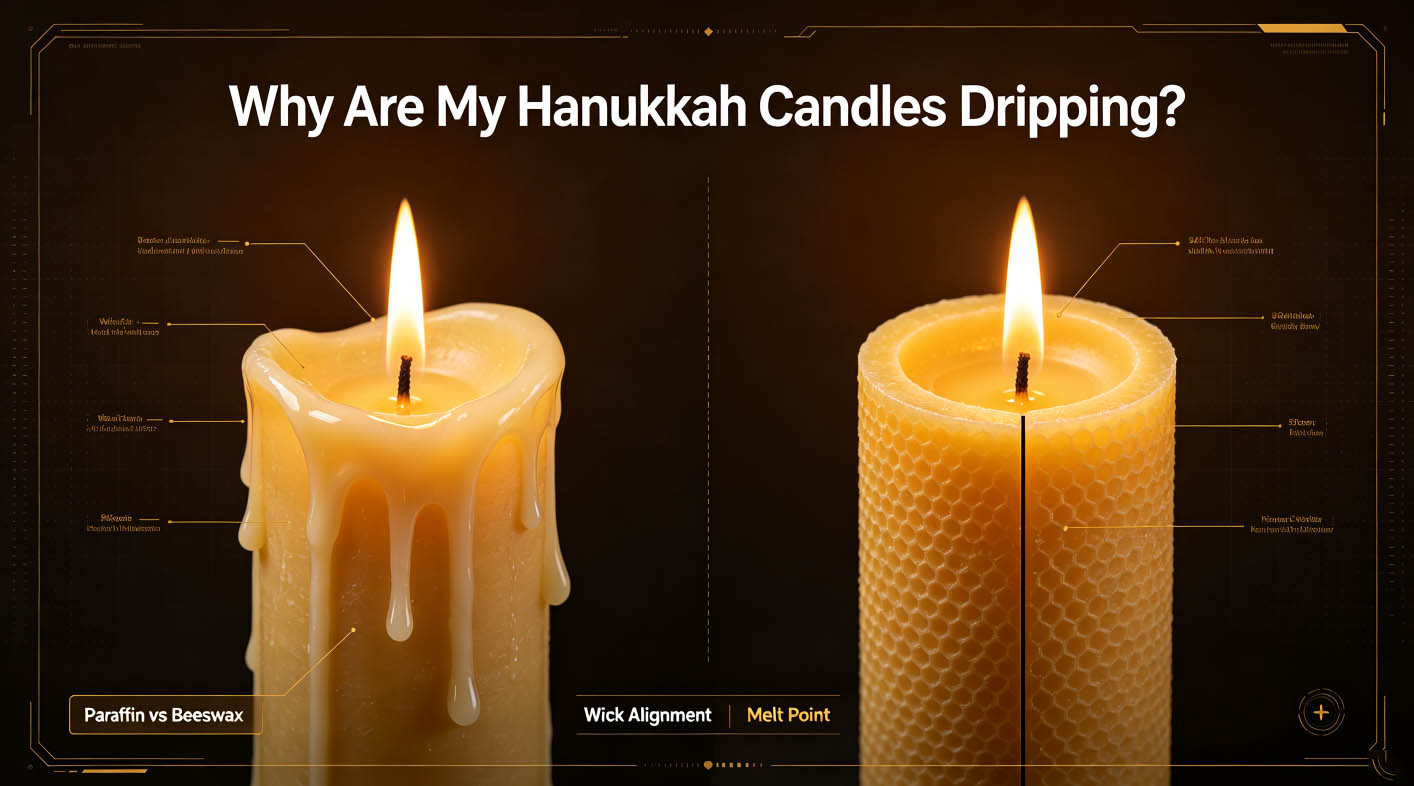
If you’ve ever celebrated Hanukkah with a menorah dotted with wax drips down the sides, stained tablecloths, or residue caked onto your candle holders, you’ve probably heard all the standard fixes: trim the wick, move it away from the vent, use a drip guard.
And if you’re like most people, you’ve probably noticed those tricks rarely fix the problem fully.
Here’s the truth most candle retailers and lifestyle blogs won’t tell you: roughly 80% of Hanukkah candle dripping issues originate in the manufacturing process, not in how you use the candle. As a professional beeswax candle manufacturer supplying synagogues and Jewish communities worldwide, we’re breaking down the actual production-side causes of dripping — and what actually works to fix it.
1. Wax Melting Point: The Foundation of Drip Performance
Dripping starts with basic physics: if the wax melts faster than the wick can draw it up and burn it, the excess wax runs down the side and drips. For Hanukkah candles — which are typically a narrow 3/8-inch diameter — this effect is amplified far more than with thick pillar candles.
Why most standard Hanukkah candles drip by default
Most mass-market Hanukkah candles are made from paraffin wax or low-grade wax blends, with a melting point of only 48–55°C. At that temperature, the heat radiating from the flame is enough to soften and melt the entire upper rim of the thin candle, not just the wax directly around the wick. The result is a wide, unstable wax pool that spills over the edge.
Pure beeswax, by contrast, has a melting point of 62–64°C. It takes significantly more heat to soften the wax wall, so the wax pool stays tight and contained around the wick. In factory side-by-side testing, pure beeswax Hanukkah candles produce roughly 80% less drip volume than paraffin equivalents under identical conditions.
The “dripless” marketing trick you should watch for
Many budget candles labeled “dripless” aren’t made with better wax — they’re formulated with added palm wax hardeners to raise melting point artificially. While this does reduce dripping, it comes with tradeoffs: the wax burns with faint soot, leaves a crumbly residue, and lacks the clean, pure burn traditionally preferred for ritual use.
2. Wick-to-Wax Matching: The Hidden Cause of Most Dripping
If you’ve ever had a candle that drips heavily down one side, or suddenly pours a large glob of wax for no obvious reason, the problem is almost always wick sizing or alignment — decisions made entirely at the factory.
Wick that’s too thick = built-in dripping
A wick that is oversized for the candle diameter will produce a flame that’s too large and hot. It melts more wax than the wick can absorb and combust, and the excess simply runs down the side.
Many cheap Hanukkah candle brands intentionally use oversize wicks to create a bright, impressive flame and faster burn time. It looks good in product photos, but it guarantees dripping in real use. At our factory, each candle diameter is matched to a specific wick gauge to maintain a balanced wax pool: melted wax volume equals burn rate.
Off-center wicks = one-sided dripping
Even a 1mm wick will cause the flame to sit off-center, continuously heating and melting one side of the wax wall. The result is uneven burning and heavy single-sided dripping.
This is an extremely common defect in low-cost poured candles, where wicks can shift during cooling. For consistent drip performance, quality manufacturers use centered wick placement fixtures and perform a 15° tilt burn test: a candle must burn for 10 minutes at a 15° angle without dripping to pass quality control.
3. Molding Process: Internal Air Pockets You Can’t See
There’s a cause of dripping that you can never spot just by looking at an unlit candle: tiny air pockets trapped inside the wax body during production.
Why poured candles “suddenly drip”
Budget Hanukkah candles are typically made by pouring liquid wax into open molds and letting it cool naturally. As the wax solidifies, small air bubbles get trapped inside. When the flame reaches one of these pockets, the wax pool collapses suddenly, and a rush of melted wax spills over the edge — the random “big drip” that comes out of nowhere.
Extruded candles = denser wax = more stable burn
Higher-quality beeswax Hanukkah candles are made by high-density extrusion: solid wax is forced through a shaped die under pressure, creating a uniform, bubble-free wax body. The wax is dense and consistent all the way through, so the wax pool stays stable and even from the first minute to the last.
This is also why hand-rolled beeswax candles can vary so much in drip performance: hand rolling leaves more variation in density and tension, while factory extrusion delivers consistent results batch after batch.
4. Do At-Home Drip Fixes Actually Work? (And Their Limits)
We’re not going to tell you those common tips are completely useless — but they only work for very specific problems. If your candle is poorly made, none of them will fully fix dripping.
Trimming the wick
- When it works: If your wick is too long and creating an oversized flame, trimming to 1/4 inch will reduce heat and cut down on dripping.
- When it doesn’t: If the wax itself has a low melting point, or the wick is already too thick for the candle diameter, trimming will only make the flame weak — and may even cause the candle to burn for less than the required 30 minutes per night, violating halachic requirements.
Moving away from drafts
- When it works: Wind distorts the flame and causes uneven heating. Paraffin candles are especially sensitive to drafts.
- When it doesn’t: Pure beeswax candles have a much more stable flame and are roughly twice as wind-resistant as paraffin. If your candle is dripping badly even in still air, draft position is not the issue.
Straightening the candle in the menorah
- When it works: A tilted candle will always drip down the lower side. This is especially common with worn brass menorahs where the candle holes have widened over time.
- When it doesn’t: If the wick itself is off-center inside the wax, straightening the candle won’t fix the uneven flame.
5. The Hanukkah-Specific Rule: Dripless Should Never Come at the Cost of Halacha
There’s one critical issue almost all generic “dripless candle” guides miss: for Hanukkah use, drip performance is secondary to meeting the halachic requirement of a minimum 30-minute burn time after nightfall.
Many cheap “dripless” candles achieve low drip by using hard wax blends and very thin wicks — but they burn out too quickly, failing the core requirement of the mitzvah. A candle that doesn’t drip but burns for only 20 minutes is not a valid Hanukkah candle.
This is why pure beeswax has been the traditional preferred choice for centuries:
- It naturally burns slower and longer, easily meeting and exceeding the 30-minute standard.
- It produces minimal dripping without chemical additives or hardeners.
- It burns clean with no soot, preserving the purity of the ritual.
- Beeswax residue is also much easier to clean off silver, brass, and ceramic menorahs, protecting valuable and antique candle holders from long-term damage.
How to Choose Truly Dripless Hanukkah Candles
If you’re tired of dealing with messy drips and want candles that perform consistently, look for these markers of quality manufacturing:
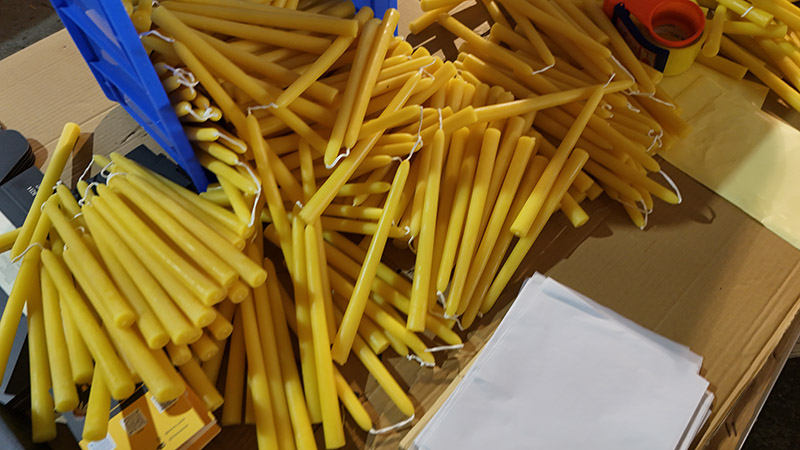
- 100% pure beeswax, no blends: Skip paraffin, palm wax blends, and candles with undisclosed wax compositions.
- Extruded construction, not poured: Denser wax means fewer air pockets and more even burning.
- Guaranteed burn time of at least 30 minutes, ideally 45+ to account for longer evening use.
- Center-aligned wicks sized for the candle diameter.
For synagogues, Jewish communities, schools, and retailers sourcing bulk Jewish candles, our factory’s high-density extruded pure beeswax Hanukkah candles are manufactured to meet both traditional ritual standards and low-drip performance. We offer standard sizes, custom packaging, and bulk pricing for community orders.
If you’d like to request samples or a factory-direct quote for your organization, reach out to our team — we’re happy to walk you through our production standards and quality testing process.