


Blog
Sourcing Hanukkah Candles: Wholesale Mistakes & Buying Checklist

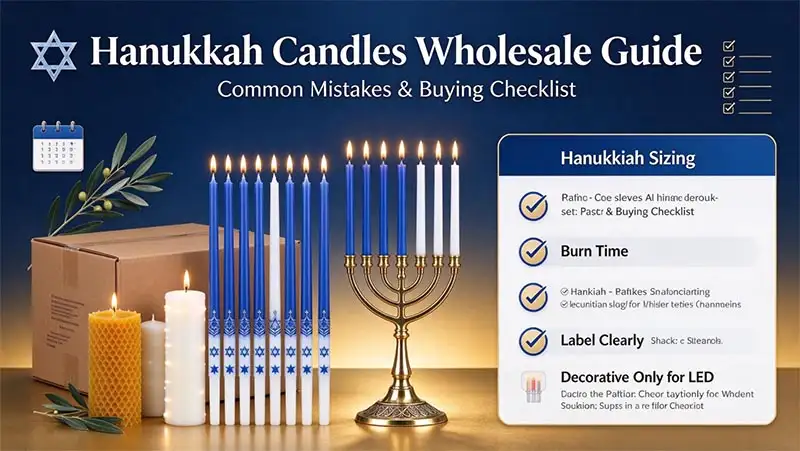
Hanukkah 2026 begins the evening of Friday, December 4 — and if you are still “planning to plan” your candle orders, this article is for you.
Hanukkah candles look like one of the simplest SKUs in the candle trade: a slim wax taper, no fragrance, no container. Yet in our 14 years of manufacturing and exporting ritual candles, the Jewish category produces more rejected containers, missed delivery windows, and dead stock than almost any other. The reason is rarely the product itself — it is that buyers apply normal wholesale logic to a category that runs on a lunar calendar, strict religious symbolism, and a four-week selling pulse.
This guide is written for wholesalers, cross-border e-commerce sellers, and gift store owners sourcing Hanukkah candles (and comparing them against church candles) from overseas factories. It covers the market structure, the calendar trap, labeling risks, spec-sheet details, profit models, buyer profiles, and a pre-order checklist you can copy into your sourcing SOP.
1. Jewish Candles vs. Church Candles: Two Completely Different Business Logics
They are both “religious candles,” they may even share the same wax and the same factory floor — but commercially they behave nothing alike.
Jewish candles are strongly seasonal. Hanukkah is the single largest spike of the year, and almost every Hanukkah SKU only moves in the weeks around the festival. The one stable exception is the Yahrzeit 7-day memorial candle, which burns year-round as families mark anniversaries of passing. Everything else — Hanukkah tapers, menorah sets, Dreidel gift boxes — is a festival-only product.
Church candles are a replenishment business. Parishes, monasteries, and Catholic bookstores consume altar and votive candles steadily through the year. Christmas and Easter create modest secondary peaks, and white pillar candles move in every season.
The sourcing implication is critical: you cannot bulk-stockpile Hanukkah candles the way you stockpile white pillars. The correct model is to lock production slots 3–4 months ahead of the festival and ship just-in-time. Inventory risk in the Jewish category is structurally much higher — unsold Hanukkah stock is dead for eleven months, then last year’s design feels stale.
2. The Hebrew Calendar Trap: Never Schedule Delivery by the Gregorian Calendar
Hanukkah starts on the 25th of Kislev in the Hebrew lunisolar calendar, so its Gregorian date drifts every year — sometimes by nearly three weeks:
- 2025: first candle on the evening of December 14, festival ends December 22
- 2026: first candle on the evening of Friday, December 4, festival ends December 12
- 2027: first candle on the evening of December 24, festival ends January 1, 2028
Wholesalers who habitually “order the same week every year” get burned repeatedly: in 2026 the season starts ten days earlier than 2025, and in 2027 it starts three weeks later. If your factory schedules production by a fixed Gregorian month, or your freight forwarder books the usual December sailing, you can miss the entire selling window even though the goods are “on time” by ordinary standards.
Rule for every buying season: verify the Hebrew calendar date for that specific year, count backwards from the first candle — retail shelf date, then container sailing date, then production start — and confirm each milestone in writing with your supplier. A reliable factory should volunteer this calculation; if yours waits for you to ask, treat it as a warning sign.
3. Labels, Symbols & Packaging: The #1 Cause of Whole-Container Rejections
In ritual candles, packaging errors are not cosmetic problems — they are religious offense, and they trigger rejection of entire shipments. These are the four highest-frequency failure points we see at B2B:
3.1 Forbidden symbols
Jewish product packaging must never feature crosses, saints, or other Christian imagery — and this includes “neutral-looking” decorative elements your designer borrowed from a church-candle catalog. The reverse also applies: church candles must not carry the Star of David. One wrong motif on a header card can mean the buyer refuses the whole batch, because reselling it in their community is reputationally impossible.
3.2 Hebrew text requires professional proofreading
Custom packaging with Hebrew wording must be proofread by a qualified reader before printing. A misspelled blessing or a wrong letter in a festival greeting is a full rejection — and unlike a color variance, it cannot be discounted and pushed through. Build proofreading time into your custom-packaging lead time: send dieline artwork to the end buyer, receive written approval, and only then release the print order.
3.3 Kosher certification: premium option, not automatic requirement
Some Jewish retail buyers request a Kosher certificate. It is not a universal hard threshold for the category, but it is a genuine value-add that unlocks premium retail channels. Clarify early in negotiation whether your buyer needs it — obtaining certification after production is far harder than planning for it before.
3.4 Label every product: Ritual-Use vs. Decorative-Only
Every listing and label must clearly distinguish ritual-use candles from decorative-only items. This matters most for LED “flameless” Hanukkah candles: if a consumer buys an electric candle expecting to fulfill the ritual blessing requirement, the resulting disappointment generates returns, one-star reviews, and sometimes cultural complaints. Clear labeling protects your downstream sellers as much as your brand.
4. Spec-Sheet Details Wholesale Buyers Most Often Overlook
4.1 Diameter: Hanukkah tapers are not ordinary tapers
Hanukkah candles are extra-slim tapers engineered to fit the candle sockets of a standard hanukkiah (the nine-branch Hanukkah menorah). Regular Shabbat taper candles are thicker — physically, they will not insert into the socket. A surprising number of suppliers list both under generic “taper candle” specs, and buyers discover the mismatch only when end customers complain. Always confirm socket diameter and candle diameter as a matched pair in the PO.
4.2 Burn time must clear the post-sunset minimum
The tradition requires the lights to burn at minimum past nightfall — roughly 30–50 minutes at minimum, though many households expect candles to burn comfortably into the evening. Undersized candles that gutter out early generate returns. Equally important, dripless performance is a core retail selling point: wax running down a hanukkiah and onto a windowsill is one of the top drivers of negative reviews in this category. Ask your factory for the dripless formulation details and test-burn data, not just a claim on the spec sheet.
5. Profit Structure: Pulse Orders vs. Steady Cash Flow
The two categories reward different financial strategies:
| Dimension | Hanukkah gift sets | Church candles |
|---|---|---|
| Order pattern | Pulse — highly concentrated before the festival | Steady replenishment all year |
| Unit margin | Higher (gift packaging adds value) | Lower per unit |
| Order size | Higher MOQ for boxed sets | Large carton, bulk-quantity orders |
| Cash flow | Lumpy, feast-or-famine | Predictable, stable |
| Inventory risk | High — dead stock if unsold | Low — always consumable |
The healthiest B2B portfolios we serve combine both: church candles provide the stable cash-flow baseline, while the Jewish festival category delivers concentrated margin spikes two or three times a year. Run either one as your only model and the business becomes fragile — pure festival = one bad season hurts badly; pure church = growth is slow.
6. Two Different Buyers: Profile Them Before You Build the Listing
Jewish candle buyers are typically Judaica gift stores, synagogue supply distributors, and Amazon/eBay cross-border sellers. They favor gift box sets, seasonal window displays, and packaging that respects the holiday’s design language.
Church candle buyers are church procurement offices, Catholic bookstores, and funeral homes. They favor plain bulk cartons, consistent specs across repeat orders, and long-term price stability over seasonal novelty.
Same factory, same wax, two completely different selling propositions — which leads to the final rule.
7. Production Can Be Shared. SKUs, Listings & Packaging Cannot.
Physically, one factory can absolutely produce both church white pillars and Jewish candles — the raw wax can even be identical. What must never be shared is the commercial identity: you cannot run one listing titled “Jewish Candle” that also says “church altar candle.” The SKU codes, product titles, descriptions, and packaging must be fully separated, because merged listings cause buyer confusion, returns, and — in this category specifically — cultural complaints that can get a seller deplatformed.
Keep one product, one audience, one language per listing. It costs nothing at the factory level and prevents the most avoidable category of disputes.
Pre-Order Buying Checklist: Copy This Into Your Sourcing SOP
- Confirm this year’s Hebrew calendar dates for Hanukkah — never reuse last year’s schedule
- Work backwards: retail shelf date → sailing date → production start; lock the factory slot 3–4 months ahead
- Match candle diameter to hanukkiah socket diameter in the PO as a paired spec
- Verify burn time exceeds post-sunset minimum; request test-burn data, not claims
- Require dripless performance evidence before committing to volume
- Submit packaging dielines for written buyer approval — no crosses/saints on Jewish packs, no Star of David on church packs
- Budget professional Hebrew proofreading into the custom-packaging timeline
- Ask early whether the buyer requires a Kosher certificate
- Label every SKU as Ritual-Use or Decorative-Only — especially LED versions
- Keep Jewish and church products on separate SKUs, listings, and packaging, always
Source From a Factory That Speaks Both Calendars
Tabo has manufactured pure beeswax and ritual candles since 2012, serving distributors and retail chains across Europe, North America, and Israel. Our team handles Hebrew-calendar production planning, symbol-safe packaging design, and dripless taper formulation as standard workflow — not as special requests.
Explore our Jewish candles wholesale program, our 7-day devotional candle line, or read our complete wholesale guide to Jewish and church candles. For a quote tailored to your season calendar, contact our export team — the earlier you lock the slot, the better the production window.


