



Blog
The Science Behind Soy Wax Candle Frosting (And How to Cure It)

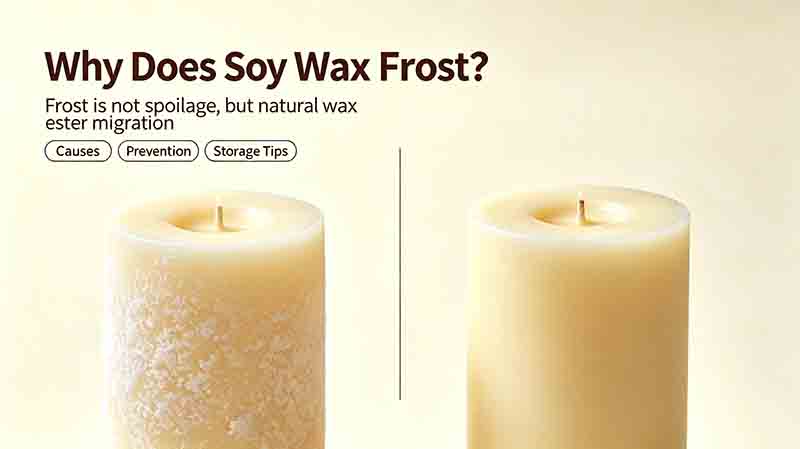
If you have ever lovingly poured or purchased a 100% natural soy candle, you might have noticed a strange phenomenon after a few days: a pale, crystalline, white mist slowly creeping across the smooth surface or hugging the glass walls. It looks a bit like winter frost or a light dusting of snow.
In the artisanal community, this is known as soy wax candle frosting. For beginners and candle lovers, spotting this for the first time can be a bit alarming. “Did I ruin my batch? Is the wax expiring? Did the manufacturer use a faulty chemical?”
Take a deep breath. As a technical team that lives and breathes wax formulations at tabo Candle Factory, we are here to tell you a comforting secret: frosting is actually a badge of honor. It is the ultimate, undeniable proof that your candle is 100% natural, pure, and completely free of toxic paraffin petroleum.
Let’s dive into the fascinating chemistry of why this happens, how the blend ratio affects it, and the factory-floor secrets on how to minimize soy wax candle frosting to keep your creations looking smooth and boutique-worthy.
The Secret Chemistry: Why Does Soy Wax “Frost”?
To understand soy wax candle frosting, we have to zoom into the molecular world of plant lipids.
Soy wax is made from hydrogenated soybean oil. At a molecular level, it consists of natural fatty acid chains. When you melt the wax and pour it into a jar, these molecules are flying around frantically in a liquid state. As the candle begins to cool down, these liquid molecules slow down and start holding hands, packing themselves into tight, orderly solid structures called crystals.
However, soy wax is a dynamic, living material. Even after the candle is fully cooled and sitting quietly on your shelf, those tiny crystals never stop moving. Over time, as the room temperature fluctuates, the soy wax tries to return to its most natural, relaxed crystalline form. As it rearranges itself, tiny micro-crystals push to the surface, creating that characteristic white, polymorphic “frost.”
Simply put: frosting is just a natural soy candle breathing. If you buy a candle that stays flawlessly glossy, chemically perfect, and rock-hard for five years without a single white blemish, it is almost certainly packed with synthetic chemical stabilizers or petroleum-based paraffin.
The Math of the Melt: Does the Soy Wax Ratio Matter?
A question we constantly get from brands and DIY hobbyists at tabo is: Does the percentage of soy wax in my candle dictate how much it frosts?
The short answer is: Absolutely, yes.
The intensity of soy wax candle frosting is directly tied to the purity of the soy. The math is simple:
- 100% Pure Soy Wax: Highly prone to frosting. It possesses a volatile polymorphic structure that reacts to every degree of temperature change in your room.
- Soy Blends (Soy-Paraffin hybrids): Frosting drops significantly. When you introduce even 20% to 30% refined paraffin, the heavy petroleum molecules act as a rigid “jail,” locking the soy crystals in place and preventing them from migrating to the surface.
- The Natural Remedy (Soy-Coconut blends): If you refuse to use petroleum but hate the white frost, the secret lies in blending soy wax with pure coconut wax. Coconut wax has a much lower melting point and a completely different molecular shape. It fills the gaps between the soy crystals, gently cushioning them and drastically reducing the chances of frosting while keeping the candle 100% plant-based and eco-friendly.
The Factory Vault: Master Craftsman Secrets to Prevent Frosting
While frosting is a beautiful sign of authenticity, we understand that you still want your candles to look as smooth and luxurious as possible. When manufacturing at scale, we use precise thermodynamic control to tame the wax.
Here are the tabo internal DIY tips to help you minimize frosting at home like a seasoned professional:
1. The Magic of Pouring Temperature
The number one mistake DIY makers make is pouring the wax when it is way too hot. If you pour boiling hot soy wax into a cold room-temperature jar, the thermal shock causes the crystals to freeze into chaos, triggering heavy frosting later.
- The Fix: Let your melted soy wax cool down patiently. Stir it gently until it just starts to look slightly opaque or cloudy (usually around 50°C to 53°C / 122°F to 127°F), then pour it with a slow, steady hand.
2. Preheat Your Glass Jars
If your glass containers are cold to the touch, the wax touching the walls will flash-cool, while the center stays hot. This uneven cooling rate is a breeding ground for heavy frosting on the sides of the jar (also known as wet spots).
- The Fix: Warm your jars gently with a heat gun or pop them in a warm oven for a few minutes before pouring. You want the glass and the wax to cool down hand-in-hand.
3. The “Slow-Cure” Sanctuary
Candles hate sudden drafts, air conditioning, or being placed on cold granite countertops while curing.
- The Fix: After pouring, let your candles cure on a wooden surface or a wire rack wrapped in a thick towel. Keep them away from windows and vents. The slower and more boring the cooling process is, the smoother the surface will be.
Crafting Flawless Nature at Home
Mastering the temperamental personality of natural soy wax is what separates an amateur from a true artisan. It takes time, trial, and error.
To help you skip the frustration and go straight to the joy of creation, we formulated the tabo Premium DIY Candle Making Kits with a highly specialized, factory-optimized Soy-Botanical Blend. We have enriched our high-purity natural soy wax with a precise, microscopic touch of organic coconut lipids.In fact, when evaluating the quality of a scented candle, the appearance of frosting indicates that high-purity plant-based soy wax was likely used.
This custom formulation acts as a natural buffer against severe soy wax candle frosting, making it incredibly forgiving for beginners. It allows you to achieve that dreamy, buttery-smooth surface and flawless jar adhesion right from your kitchen counter—all while maintaining the clean, honest, pet-safe, and eco-friendly burn that your home deserves.