



Blog
How to Tell Pure Beeswax Candles Apart From Paraffin Blended Fakes

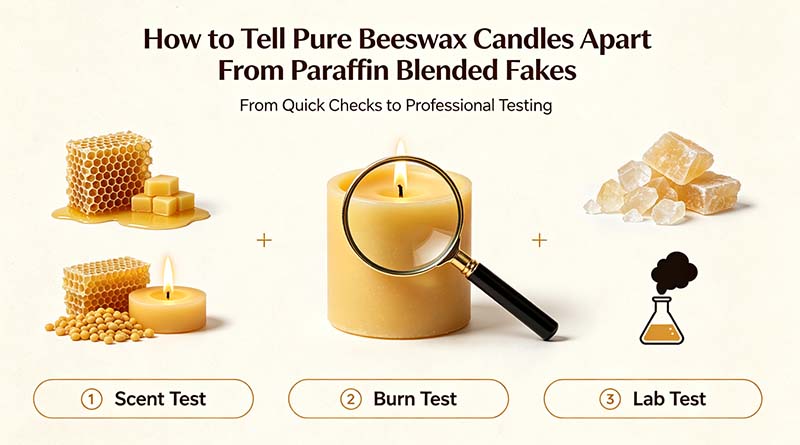
For overseas candle importers and Amazon sellers, “100% pure beeswax candles” have become one of the most high-risk categories in cross-border procurement. Many buyers encounter awkward situations: products labeled pure beeswax either produce heavy black smoke, carry chemical fragrances, or fail third-party testing, resulting in customs rejection, Amazon listing delisting and customer complaints.
Most buyers simply attribute fake beeswax candles to “dishonest Chinese suppliers”, but the real cause is a multi-party market game involving customer demand characteristics, product attribute conflicts, profit models and cross-border platform rules.
This guide adopts a from-easy-to-core identification logic, sorting out zero-cost visual discrimination methods for small buyers and professional testing solutions for bulk importers. Combined with the industry data and supplier audit standards in our Chinese pure beeswax candle overseas procurement white paper, it thoroughly explains the root causes of paraffin blending and provides targeted risk avoidance suggestions for cross-border procurement.
Why Paraffin-Blended Fake Beeswax Candles Flood the Market (Multi-Dimensional Root Cause Analysis)
The proliferation of counterfeit beeswax candles is never a one-sided problem of supplier cutting corners. It is the result of the mismatch betweennatural attributes of pure beeswax, market consumer demand, profit-driven logic and cross-border sales rules.
1. Inherent Contradiction Between Pure Beeswax Traits and Consumer Demand
Pure natural beeswax has fixed physical and chemical properties formed by bee secretion, which cannot be artificially modified. However, most terminal consumers and small-batch buyers hold wrong rigid demand, forcing suppliers to blend paraffin to compromise:
- Fragrance demand conflict: Pure beeswax only has a faint natural honey aroma and cannot carry strong, rich or long-lasting artificial fragrances. Many buyers insist on “pure beeswax + strong custom fragrance”. To meet this demand, suppliers have to blend a large amount of paraffin (which is highly compatible with synthetic essence) to retain strong fragrance, resulting in impure beeswax components.
- Appearance and hardness demand conflict: Pure beeswax is soft and flexible at room temperature, easy to deform during transportation, and has natural color differences. Consumers prefer hard, smooth, bright white and flawless candles. Paraffin can perfectly meet high appearance requirements, so blending becomes the only way to balance appearance and customer expectations.
- Burning effect misunderstanding: Pure beeswax burns slowly with a small wax pool, while many consumers take “fast burning and full wax pool coverage” as a sign of good quality. Paraffin burns fast and evenly, which caters to wrong consumer cognition and accelerates the popularity of blended products.
2. Huge Profit Gap Drives Low-End Market Blending Behavior
According to the raw material cost data in the industry white paper, pure beeswax raw material cost is 3–5 times higher than industrial paraffin. For small uncertified workshops and cross-border resellers, paraffin blending brings huge profit margins:
- Pure beeswax procurement and refining costs are high, with thin profits for formal manufacturers relying on large-scale production;
- Blending 70%–90% paraffin with a small amount of beeswax can reduce costs by more than 60%, supporting ultra-low-price competitive listings on Amazon and other platforms;
- Small workshops cannot afford international certification and testing fees, and can only rely on cost reduction through blending to survive in low-price orders.
3. Platform Supervision Loopholes and Demand Fragmentation Amplify Counterfeiting
Amazon’s low entry threshold allows a large number of unqualified resellers without factories to enter the market. These sellers do not have stable pure beeswax supply chains and can only purchase blended products from small workshops to support low-price traffic. Meanwhile, scattered small-batch retail orders lack strict quality supervision, forming a closed loop of “low price + blending + high sales volume”.
Level 1 Identification: Zero-Cost Visual & Sensory Judgment (Suitable for All Small-Batch Buyers)
This is the most convenient and fast discrimination method without any tools, suitable for sample inspection and spot check of retail orders, which can quickly screen out most low-end fake beeswax candles.
1. Scent Identification (Core Sensory Feature)
Pure Beeswax: No strong artificial fragrance. Even unscented products have a faint, natural and lasting honey sweetness. Scented pure beeswax candles have soft and not pungent fragrance, with honey notes as the base tone.
Paraffin Blended Fakes: No natural honey aroma. The scent is either dull and odorless or strong, pungent and artificial plastic fragrance. The fragrance floats on the surface and dissipates quickly after burning.
2. Burning State Observation
Pure Beeswax: The flame is stable, mild and upright, with almost no black smoke. The wax pool is uniform and clean, no dripping wax, no pungent volatile odor during combustion, and clean candle walls after burning.
Note: When conducting a combustion test, it is important to be aware of the influence of external factors on the candle’s combustion.
Paraffin Blended Fakes: Fast burning speed, unstable flame, easy to produce dense black smoke. It is prone to wax clinging and dripping, and will release faint plastic and chemical odor during long-time burning.
3. Room Temperature Texture & Color Judgment
Pure Beeswax: Warm natural honey yellow or milky white after physical decolorization. Soft and flexible at room temperature, pinchable and malleable, with fine granular fracture surfaces.
Paraffin Blended Fakes: Too bright white or rigid dull color. Hard and brittle texture, easy to break, with smooth plastic-like surface gloss and no natural wax texture.
Level 2 Identification: In-Depth Practical Test Method (Suitable for Overseas Procurement Sample Inspection)
On the basis of sensory judgment, this set of operable physical test methods can further eliminate intermediate blended products with low beeswax content, which is fully suitable for overseas importers’ sample confirmation before bulk orders.
1. Bending & Fracture Test
Cut a small piece of candle wax and bend it gently at room temperature. Pure beeswax can be bent into an arc without breaking, with fine natural grain on the fracture surface. Paraffin blended wax is rigid and brittle, which will break directly when bent, with a smooth and flat fracture surface without granular texture.
2. Long-Time Burning Residue Test
Burn the sample for 2–3 hours continuously. Pure beeswax leaves no black residue on the candle cup and surrounding environment, with clean wax residue. Paraffin blended candles will produce black soot residue, and the residual wax liquid is turbid and easy to solidify into uneven blocks.
Level 3 Core Identification: Professional Standard Testing (Bulk Procurement Zero-Risk Solution)
For B-end bulk importers, sensory and physical tests are not enough. Third-party professional testing is the only authoritative basis to avoid customs rejection and platform complaints, which is also the core standard of formal supplier audit in our beeswax candle supplier audit checklist.For example, the test report for Tabo from the Chinese Academy of Sciences.
1. Comply with GB/T24284 National Standard Testing
Genuine pure beeswax must meet China’s official beeswax standard GB/T24284, with fixed melting point (62–67°C), acid value, saponification value and ash content range. Paraffin blended products will have obvious deviation in physicochemical indicators.
2. SGS/BV Third-Party Impurity Detection
Submit samples to internationally recognized institutions such as SGS and BV for paraffin component detection. Advanced ATR-IR spectroscopy can detect paraffin impurities as low as 5%, which can 100% accurately identify blended fake beeswax and provide official test reports for customs clearance and platform review.
Essential Analysis: Amazon Counterfeit Beeswax Is a Multi-Party Game Result
After sorting out the identification methods and false-making causes, it is clear that the large number of fake beeswax candles on Amazon is not the quality problem of China’s formal beeswax industry, but a balanced result of multiple market parties:
- Consumer end: Wrong demand for “pure beeswax + strong fragrance + ultra-low price + perfect appearance” violates the natural attributes of beeswax, forcing suppliers to compromise and blend;
- Supplier end: Small workshops rely on paraffin blending to reduce costs and seize low-price markets; formal manufacturers stick to pure beeswax craftsmanship but lose low-price traffic;
- Platform end: Low entry threshold and listing hijacking mechanism make low-price blended products occupy top search rankings, forming wrong market guidance;
- Procurement end: Small buyers rely on platform retail stock for trial orders, resulting in multi-layer resale and high counterfeit rate, while direct factory bulk orders have a qualified rate of over 98%.
Professional Procurement Suggestions for Overseas Importers
To completely avoid paraffin blended fake beeswax candles, overseas buyers need to abandon single price judgment and platform retail procurement habits, and establish standardized procurement logic:
- Correct product cognition: Accept the natural traits of pure beeswax (faint honey aroma, soft texture, slow burning), and do not pursue contradictory demands such as strong artificial fragrance and ultra-low price, so as to fundamentally eliminate the living space of blended products;
- Prioritize factory direct supply: Abandon Amazon retail ready stock channels, cooperate with formal certified manufacturers with complete REACH, FDA and PAHs certifications, and traceable raw material supply chains;
- Implement sample testing mechanism: Conduct sensory preliminary inspection first, and arrange third-party professional testing for bulk order samples to ensure compliance with national standards and export regulations;
- Standardize supplier audit: Follow the full set of audit processes in the supplier checklist, verify enterprise qualifications and export records, and eliminate unqualified small workshops and resellers;
- Sign restrictive contract clauses: Clearly stipulate 100% pure beeswax requirements and breach compensation liabilities in the procurement contract to ensure batch quality consistency.
Conclusion
Pure beeswax candles have irreplaceable natural physical and chemical traits, and paraffin blending is essentially a market compromise under the contradiction of wrong demand, profit drive and platform rules. There is no widespread quality problem in China’s formal beeswax manufacturing industry.
By adopting the hierarchical identification method from sensory judgment to professional testing, and matching standardized factory direct procurement and supplier audit mechanisms, overseas importers can completely eliminate fake beeswax candle risks and build a stable, high-quality and cost-effective long-term procurement system.