



Blog
Church Candle Institutional Buying Differences And Real‑World Parish Community Insights

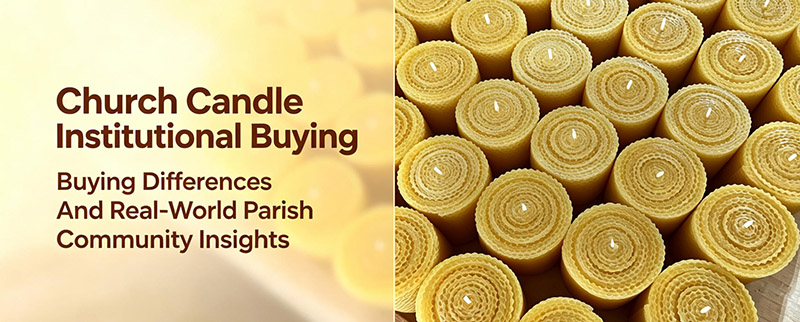
This article is a church-specific professional supplement to our 2026 Prayer Candle Buying Guide. While the main guide covers universal home and bulk prayer candle knowledge — including burn time, color symbolism, and detailed wax material comparisons — this guide focuses exclusively on institutional church procurement standards, real parish community feedback, and the core differences between church altar candles and home prayer candles. It delivers unique, non-repetitive purchasing value for parishes, church administrators, and religious goods importers.
Quick Overview
Most church procurement teams mistakenly apply home prayer candle selection standards to institutional altar purchases, resulting in unstable burning, high maintenance costs, and mismatched liturgical specifications. Unlike personal home devotion, church candle procurement requires long-term batch stability, venue environment adaptability, and strict liturgical compliance. Combined with real usage feedback from global church practitioner communities, this guide differentiates church-grade and home-grade candle standards and clarifies the best wax materials for different church scenarios.
Exclusive Core Difference: Church Altar Candles vs. Home Prayer Candles
Although church altar candles and home prayer candles share similar devotional purposes, their design thresholds, usage environments, and procurement logics are essentially different. This differentiated analysis is not repeated in the general prayer candle buying guide and forms the core unique value of this church professional guide.
1. Venue Environment & Burning Stability Standards
Home prayer candles are used in small, closed, stable household spaces with short burning cycles and human-supervised combustion. Church venues feature large open halls, long-term air convection, frequent ventilation, and uninterrupted group worship burning. Therefore, church-grade candles must resist tunneling, flame flickering, and high-temperature softening — strict stability requirements that ordinary home prayer candles cannot satisfy.
2. Liturgical Canon Compliance Threshold
Personal home prayer has no rigid material or ritual restrictions. Formal church masses, weddings, baptisms, and major festival ceremonies follow traditional canonical rules. Core altar candles require qualified wax purity and religious symbolic attributes, forming a professional industry threshold that civilian home candles do not need to meet.
3. Batch Procurement & Hidden Operating Costs
Home purchases only focus on single product quality and personal experience. Church procurement belongs to annual institutional fixed-order purchasing, which requires consistent batch quality, stable long-term supply, and low post-use maintenance costs. Many parishes eliminate low-cost inferior candles not only for poor burning performance, but to avoid continuous hidden costs such as altar soot pollution, fabric staining, and religious facility cleaning and maintenance.
4. Warehousing & Cross-Border Shipment Adaptability
Church inventory needs seasonal large-scale stock preparation and long-term storage, plus long-distance ocean transportation for global church suppliers. Church candles require high melting point and anti-deformation performance. In contrast, home prayer candles have small inventory turnover and no strict requirements for transportation stability.
Wax Material Selection: Brief Reference
For detailed comparisons of beeswax, paraffin-palm blended wax, and soy wax — including composition, burn characteristics, pricing, and civilian use cases — please refer to our complete 2026 Prayer Candle Buying Guide, which covers this topic in depth.
For church institutional procurement, the key takeaway is simple: match wax type to liturgical solemnity and usage frequency. High-solemnity ceremonies require pure beeswax for canonical compliance; weekly masses and large-batch inventory work best with premium paraffin-palm blends for cost efficiency and batch consistency; soy wax is limited to auxiliary, non-ceremonial prayer settings.
Real Global Church Community Procurement Insights (Authoritative Third-Party Perspective)
To avoid one-sided manufacturer-oriented marketing content, this guide integrates real procurement experience, long-term venue usage feedback, and practical material selection strategies shared by parish priests, church administrators, and volunteer purchasers from professional religious communities including Reddit r/Catholicism, Reddit r/OrthodoxChristianity, and the Catholic Answers Forums.
Community Insight 1: Soot and Altar Maintenance Is the #1 Hidden Cost
Multiple parish administrators in Catholic Answers Forums and r/Catholicism report that low-cost candles produce excessive soot that stains altar cloths, walls, and ceiling fixtures over time. The hidden cleaning and restoration costs far exceed the upfront savings. One parish sacristan shared that switching to a higher-quality blended wax reduced their annual altar cleaning budget by approximately 40%. This is a cost factor that home prayer candle buyers never encounter — and one that cheap wholesale catalogs never mention.
Community Insight 2: Batch Consistency Matters More Than Individual Candle Quality
Church purchasers in r/OrthodoxChristianity emphasize that for annual bulk orders, consistency across batches is critical. A single good sample does not guarantee that 5,000 units will burn identically. Inconsistent wax formulas can lead to some candles tunneling or dripping excessively during services, creating visible disruptions during mass. Home buyers only need one candle to perform well; church buyers need every single unit in a shipment to perform identically — a fundamentally different quality standard.
Community Insight 3: Ventilation and Church Architecture Directly Affect Candle Performance
Several community members point out that a candle that performs perfectly in a small home or side chapel may fail in a large, drafty church with high ceilings and frequent door openings. Church-grade candles need a higher melting point and a more stable flame formula to withstand these environmental factors. One purchaser in r/Catholicism described how candles marketed as “long-burning” performed well in their home but constantly flickered and tunneled in their 800-seat parish church — a requirement that home prayer candles simply are not designed to meet.
Community Insight 4: Liturgical Compliance Is Non-Negotiable for Core Ceremonies
Priests and liturgy coordinators in these communities stress that for Easter Vigil, Christmas, weddings, and funerals, altar candles must meet traditional purity standards (historically requiring a high beeswax content). Using non-compliant candles for these sacraments is not merely a quality issue — it is a liturgical concern that many parishes will not compromise on, regardless of cost savings. This is the single biggest differentiator between church candle procurement and any consumer candle purchase: spiritual and canonical requirements override budget considerations for key ceremonies.
Final Procurement Recommendation for Church Buyers
Church candle procurement is fundamentally different from home prayer candle shopping. The decision should be driven by liturgical compliance, venue environment, batch consistency, and long-term maintenance costs — not just upfront unit price. Based on the institutional differences and community feedback outlined above, here is the actionable procurement framework for parishes and religious goods importers:
- Reserve pure beeswax candles for high-solemnity sacraments and major feasts where canonical standards and religious symbolism are non-negotiable. This is not an area to cut costs.
- Use premium paraffin-palm blended wax for weekly masses, devotional services, and bulk inventory — it offers the best balance of stable combustion, batch consistency, and cost efficiency for high-volume institutional use.
- Avoid soy wax for formal altar use; limit it to casual, non-liturgical prayer spaces if at all. Its poor high-temperature stability and tunneling tendency make it unsuitable for drafty church environments.
- Always request batch samples and verify long-term burn performance in your actual church environment before committing to large annual orders. A sample that burns well in a small room may fail in your sanctuary.
- Partner with a manufacturer that can demonstrate consistent batch quality, adequate warehousing capacity, and reliable cross-border supply — these operational factors determine whether your procurement remains trouble-free year after year, far more than the per-unit price on a quote sheet.
For a complete wax material breakdown, color symbolism guide, and general prayer candle knowledge for both home and bulk use, visit our 2026 Prayer Candle Buying Guide.