



Blog
What Makes a “Clean‑Burning” Candle? Health, Wax Types & Practical Candle Care

If you’ve browsed candle threads on Reddit, you’ve definitely seen the debate: which candles actually burn clean? Many people shop for clean‑burning options out of concern for indoor air quality, personal respiratory health, and environmental impact.
Online discussions often swing between two extremes — “all candles are toxic” and “natural‑wax candles are completely risk‑free”. The reality sits somewhere in‑between. Today we break down real‑world health impacts, what makes candles burn clean, manufacturing variables, simple candle‑care habits, and which wax performs best.
How Much Do Burning Candles Actually Impact Human Health?
Any combustion process releases trace particulates, VOCs and carbon‑related emissions, candles included. That said, real‑world household exposure data shows that under normal home use, health risks from candle burning are very small for most healthy people.
Lab studies that generate scary headlines are frequently run inside fully sealed small test chambers, with zero ventilation and extended non‑stop burn times — conditions almost nobody replicates in real‑life homes. In regular living spaces with typical air exchange:
- Fine‑particle and volatile‑organic levels rise temporarily while lit, but drop quickly back to background baseline shortly after you blow the candle out.
- WHO exposure thresholds for concerning compounds like benzene are rarely reached during casual candle use in ventilated rooms.
This is not to say emissions are zero. People with asthma, allergies or sensitive respiratory systems may still experience mild irritation, especially from heavily‑scented paraffin candles burned for hours in closed‑off rooms. (For asthma sufferers: only 100% pure natural beeswax pillar candle are recommended). For the average household though, occasional candle lighting poses minimal measurable health risk.
Key takeaway: Health risk comes far more from poor ventilation + frequent long burns than simply lighting a candle occasionally. Wax type will shift how much pollution you generate in the first place. Many shoppers also encounter the popular myth that natural candles can purify indoor air, which we break down with factual testing in our separate article.
Wax Type: The #1 Factor That Determines Clean‑Burning Performance
No single variable matters more for soot, particulate output and burn cleanliness than your candle base wax.
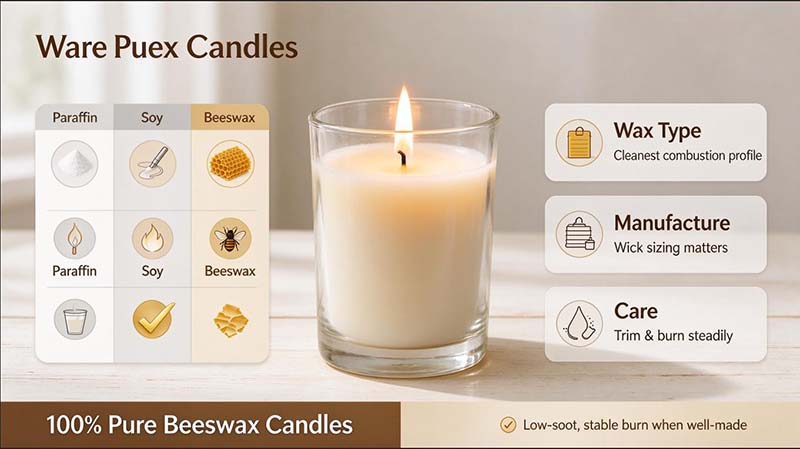
Paraffin, soy wax, and beeswax are the three dominant consumer‑grade waxes on the market. Lab combustion testing reveals clear gaps in their emission profiles. You can review independent comparative test data covering soot, PM2.5 and air‑quality metrics here: 👉 Beeswax / Paraffin / Soy Candle Combustion & Air Quality Test Report
- Paraffin (petroleum‑derived):Highest soot and particulate output among common candle waxes. Incomplete combustion easily creates visible black soot on jars and nearby surfaces. Heavily‑fragranced paraffin amplifies VOC release further.
- Soy wax:Burns far cleaner than standard paraffin, drastically cutting soot production. Important caveat: many “soy candles” sold retail are wax blends mixed with paraffin. Only 100% pure soy delivers the expected cleaner‑burn benefits.
- 100% pure beeswax:Delivers the cleanest combustion profile of mainstream candle wax options. Beeswax burns at higher temperature and achieves more complete combustion, producing nearly zero visible soot under correct burning conditions.
Even with premium wax, poor manufacturing can ruin burn performance. Wax alone does not guarantee perfect results.
Manufacturing & Production Factors That Ruin Clean Burn (Beyond Wax Material)
Even if you buy candles advertised as natural or premium, production‑related mistakes will create smoking, sooty, uneven‑burning candles. These are the most critical factory‑level variables:
- Wick‑to‑vessel sizing & wick matching This is the single biggest manufacturing failure point. An undersized wick cannot generate enough heat to melt wax fully across the jar, leading to tunneling, sputtering flame and incomplete combustion. Over‑sized wicks create over‑tall flames, excess soot and carbon buildup (“mushrooming”) on wick tips. Quality candle makers run multiple burn tests to match wick thickness to wax melting point and container diameter.
- Wax blending & adulteration Brands may mix cheap paraffin into soy or beeswax to lower costs, without clear labeling. Blended wax will show emission characteristics of its lowest‑quality component.
- Fragrance load and fragrance‑oil quality Adding high percentages of synthetic fragrance oil raises VOC output across all wax types. Over‑loading fragrance can disrupt stable combustion, causing flickering and extra smoke, regardless whether base wax is soy or beeswax.
- Wax curing and pouring temperature Improper pouring temperature or insufficient curing time leads to unstable melt pools, uneven flame behavior, and increased soot risk.
- Wick material quality Always seek lead‑free cotton or hemp‑core wicks. Old‑style metal‑core wicks containing lead are banned in most regions, but cheap imports can still contain low‑grade metal cores.
Simple Habits To Keep Your Candle Burning Clean & Stable
Great manufacturing gets you halfway. How you treat your candle directly determines real‑world burn quality. These easy habits reduce soot, prevent tunneling, maximize burn life:
- Respect the first‑burn rule On your very first lighting, allow the wax pool to melt fully all the way out to the container edges (typically 2‑3 hours for most jar candles). If you blow it out early, wax creates a “memory ring”, and the candle will permanently tunnel down the center on future burns.
- Trim your wick before every single burn Trim wick down to ¼ inch (~6 mm). Clip off all carbon “mushroom” buildup before lighting. Long wicks create oversized flickering flames and heavy soot. Discard wick trimmings from wax pool before re‑lighting.
- Burn candles in draft‑free locations Keep candles away from fans, air‑conditioning vents, open windows. Air drafts push the flame sideways, cause uneven heating and incomplete burning, even for high‑quality candles.
- Limit single burn sessions Do not burn container‑style candles non‑stop for more than 4‑5 hours continuously. Extended burns overheat the vessel and worsen emissions. Allow full cool‑down before relighting.
- Keep wax pool free of debris Matches, wick clippings and dust floating in melted wax disrupt stable flame and generate smoke.
Which Candle Should You Pick for Clean Burning?
If clean‑burn performance is your top priority:
✅ 100% pure beeswax candles deliver the best overall combustion performance among widely‑available candle options. With properly‑matched wicks, beeswax produces minimal soot and stable clean‑burning flames, releasing its subtle natural honey aroma without heavy synthetic fragrance. They are an excellent pick for meditation spaces, yoga studios, home decor and memorial use. (For asthma sufferers: only 100% pure beeswax candles are recommended)
✅ 100% pure soy candles are a solid budget‑friendly cleaner‑burning alternative. Always verify labelling to confirm it is non‑blended pure soy wax.
Paraffin candles can be enjoyed occasionally with good ventilation, but expect higher soot and particulate output compared to natural‑wax alternatives.
Final thought: No candle is “zero‑emission”. Even beeswax creates trace combustion by‑products. Pair good wax selection with simple candle‑care habits and reasonable ventilation to get the best balance of cozy atmosphere and indoor‑air quality.