



Blog
Beeswax Candles: Why Some Are Yellow & Some Are White — Is White Beeswax Fake?

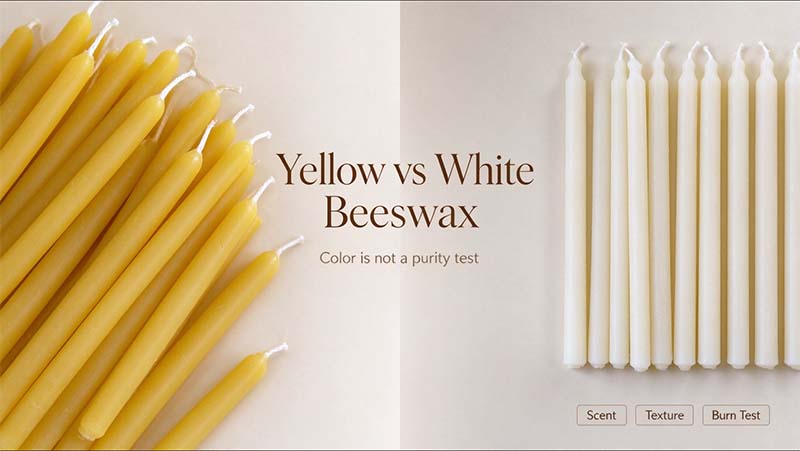
Not all white beeswax candles are fake. Natural beeswax is originally yellow, while legitimate white beeswax is made by refining and bleaching raw yellow beeswax without paraffin additives. However, ultra-bright, cheap white candles on the market are mostly paraffin blends. Color cannot determine authenticity — always judge by scent, texture, burning performance and professional testing.
Why Beeswax Candles Are Yellow or White?
Pure raw beeswax harvested directly from beehives naturally presents a warm golden yellow or light amber hue. Its natural color comes from organic substances like pollen, propolis and nectar residues. Different bee species and nectar sources create subtle color differences, which is a completely normal natural feature.
White beeswax, by contrast, does not exist in nature. It is processed from raw yellow beeswax through professional decolorization and purification. There are two mainstream legitimate bleaching processes:
- Physical mild bleaching: Using activated carbon adsorption or natural sun exposure to remove natural pigments and impurities. This process does not add any paraffin, chemical wax or synthetic ingredients, retaining 100% pure beeswax properties, only slightly weakening the natural honey aroma.
- Chemical bleaching: Adopting food-grade oxidants for rapid decolorization. Standardized operation keeps the wax pure, but inferior processing may leave subtle chemical residues and affect the burning texture.
Core Reminder: White beeswax ≠ fake beeswax, and yellow beeswax ≠ 100% genuine. Unscrupulous suppliers use low-cost paraffin to make bright white fake candles, or mix paraffin into yellow beeswax to pretend to be pure raw wax. Color alone is never a reliable identification standard.
Cost Differences: Yellow vs White Beeswax Candles
The price gap between the two is derived from processing procedures, not raw material purity:
- Yellow beeswax: Minimal processing, only simple filtration to remove hive impurities. No bleaching and decolorization steps, saving time and processing costs. It is the most cost-effective original pure beeswax material.
- Genuine white beeswax: Requires additional purification, filtration and bleaching processes, with certain material loss during production. Under the same purity standard, white beeswax costs 15%–30% more than yellow beeswax.
Sourcing Red Flag: If you encounter ultra-low-priced bright white “pure beeswax candles” on e-commerce platforms, they are almost certainly paraffin-blended fakes. Real white beeswax has higher production costs and cannot be sold at a bargain price.
For a complete professional identification guide to distinguish pure beeswax from paraffin-blended products, check out our in-depth article: How to Tell Pure Beeswax Candles Apart From Paraffin Blended Fakes
Yellow vs White Beeswax Candles: Pros, Cons & User Preference Comparison
Pure yellow and white beeswax candles have their own unique characteristics and target audiences. The following table clearly shows their differences in appearance, scent, performance and applicability:
| Comparison Dimension | Yellow Pure Beeswax Candles | White Pure Beeswax Candles |
|---|---|---|
| Natural Scent | Strong, pure and lasting natural honey sweet aroma, original ecological fragrance | Light and soft honey scent, slightly weakened after bleaching, almost no obvious strong fragrance |
| Appearance & Texture | Warm natural golden yellow, natural batch color difference, soft and flexible texture | Clean milky white/ivory white, uniform and flawless color, neat and high-end appearance |
| Processing & Cost | Simple processing, low cost, high cost performance | Multiple purification & bleaching processes, higher processing cost |
| Advantages | 100% original natural traits, rich honey aroma, stable burning, high recognition of pure beeswax, suitable for bulk low-cost procurement | Modern and minimalist aesthetic, easy to match various home styles, convenient for custom colored candles and light fragrance customization |
| Disadvantages | Unavoidable natural color difference, not suitable for bright color customization, single style | Weak honey scent is easy to be mistaken for fake wax, higher selling price, easy to be confused with paraffin fakes |
| Target Users & Scenarios | Suitable for users who love natural ecology, retro rustic style, and pursue original pure beeswax experience; perfect for daily household use and gift giving | Ideal for modern minimalist home decoration, commercial scene display, customized candles, and users who prefer faint or custom fragrance |
Common Market Misconception
Many overseas consumers hold the wrong view that “the whiter the candle, the purer the beeswax”. This wrong demand directly promotes the proliferation of paraffin-blended white fake beeswax candles. Paraffin wax can be made extremely white and hard at a very low cost. Unscrupulous suppliers mix a small amount of beeswax with a large proportion of paraffin to cater to this aesthetic preference, resulting in a large number of non-compliant products on the market.
3 Zero-Cost Ways to Tell Real White Beeswax From Paraffin Fakes
Since color is not credible, use these simple sensory tests to quickly screen out most inferior fake candles, suitable for sample inspection and spot checks:
1. Scent Test
Genuine white beeswax: No pungent chemical or plastic smell, with a faint, natural honey sweetness.
Paraffin blends: Completely no honey aroma, either odorless or with strong, floating artificial fragrance that fades quickly after burning.
2. Room Temperature Bend & Fracture Test
Genuine white beeswax: Soft and flexible at room temperature, bendable without easy breaking, with fine granular texture on the fracture surface.
Paraffin blends: Hard and brittle, breaks with a slight bend, with a smooth plastic-like fracture surface and no natural wax texture.
3. Long Burning Test
Genuine white beeswax: Stable and upright flame, almost no black smoke, clean wax pool and candle wall, no irritating odor during combustion.
Paraffin blends: Unstable flickering flame, easy to produce black soot, prone to wax dripping, and releases faint plastic chemical odor after long-time burning.
Professional Sourcing & Risk Avoidance Tips
For bulk cross-border importers and Amazon sellers, simple manual tests are not enough. To avoid customs rejection, platform delisting and customer complaints, we recommend standardized procurement rules:
- Abandon the wrong judgment of “whiter = purer”, and accept the natural traits of pure beeswax;
- Prioritize factory direct supply with complete certifications (REACH, FDA, PAHs) and traceable supply chains;
- Implement a sample testing mechanism: conduct manual sensory inspection first, and arrange SGS/BV third-party ATR-IR spectroscopy testing for bulk orders (can detect paraffin impurities as low as 5%);
- Standardize supplier audit and sign restrictive contract clauses to guarantee product purity and compensation for breach of contract.
For full supplier audit standards and professional testing solutions, please read our exclusive industry guide: How to Tell Pure Beeswax Candles Apart From Paraffin Blended Fakes.If you are interested in wholesale beeswax candles, please feel free to contact us immediately.