


Blog
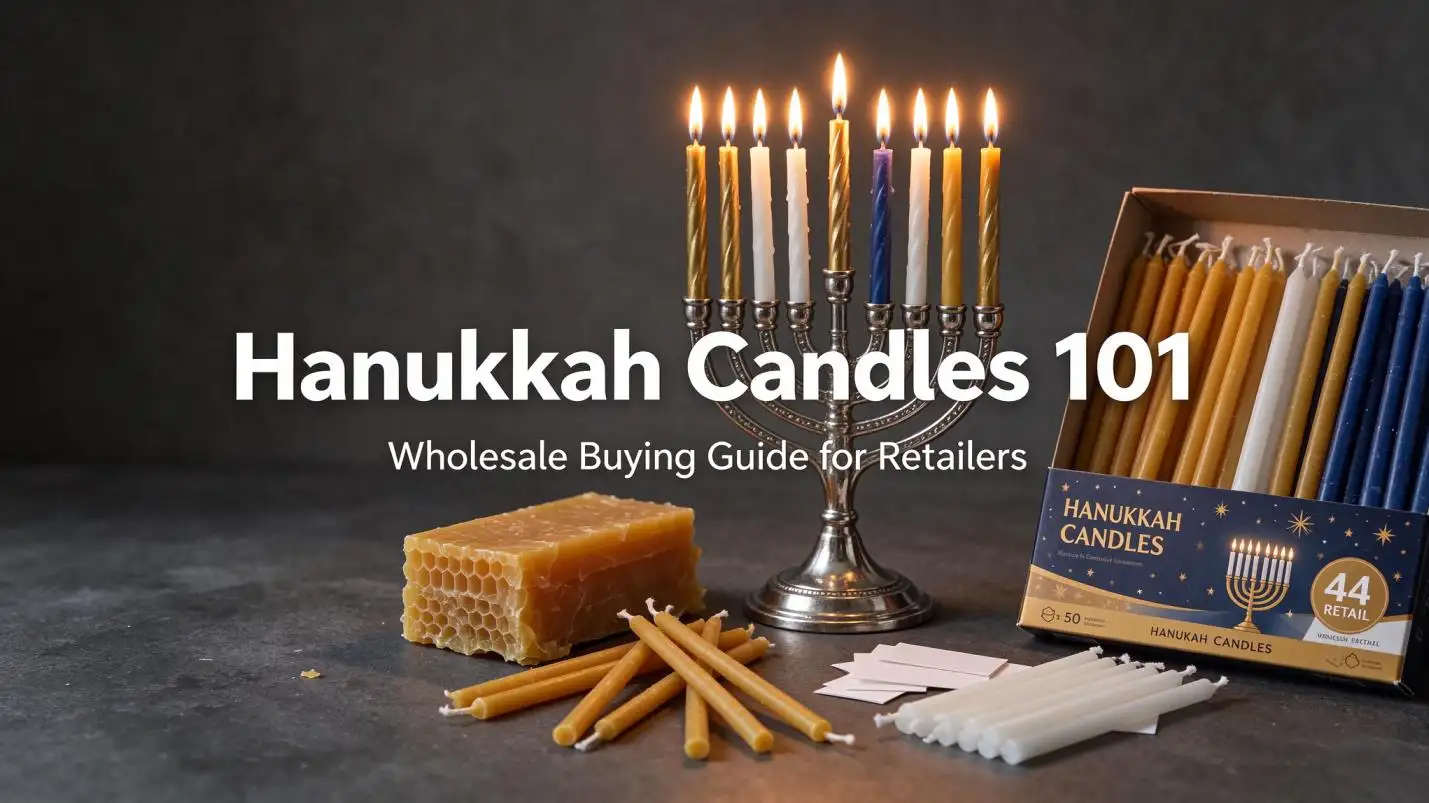
Hanukkah Candles 101

One Holiday, Eight Nights, One Set of Rules Worth Knowing
Hanukkah — the Jewish Festival of Lights — runs for eight nights, and on every one of them a menorah gains one more flame. In 2026, Hanukkah begins at sundown on Friday, December 4, and ends at nightfall on Saturday, December 12, with the eighth candle lit on the evening of Friday, December 11.
Whether you’re lighting your first menorah, hosting family for the holiday, or a shop owner preparing for the seasonal rush, the same practical questions come up every year: When exactly do we light? Which direction do the candles go? What if I forgot to buy candles? And what can stores do to stock and store them properly?
This guide answers all five — clearly, practically, and without requiring a rabbinic degree.
1. When Does Lighting Start — and Which Way Do the Candles Go?
Timing: Sundown, Not Midnight
- The candles are lit each evening, right after sunset — traditionally at dusk, when people are still out on the streets and can see the lights. The Jewish day begins at sunset, so the “first night” falls on the evening of December 4, 2026.
- Minimum burn time: the candles must stay lit for at least 30 minutes after nightfall (many households use 45–60 minute candles to be safe). So a candle that flickers out in five minutes won’t do.
- Two important exceptions: because Jewish law prohibits lighting fire on the Sabbath, on Friday evenings the candles are lit before sundown (before the Shabbat candles), and on Saturday night they are lit only after nightfall. In 2026 both the first night (Dec 4) and the eighth night (Dec 11) are Fridays — so check those two dates carefully.
| Night | Evening of | Candles Lit (+ Shamash) |
|---|---|---|
| 1st | Fri, Dec 4, 2026 | 1 + shamash (before sundown — Erev Shabbat) |
| 2nd | Sat, Dec 5, 2026 | 2 + shamash (after nightfall — Saturday night) |
| 3rd | Sun, Dec 6, 2026 | 3 + shamash |
| 4th | Mon, Dec 7, 2026 | 4 + shamash |
| 5th | Tue, Dec 8, 2026 | 5 + shamash |
| 6th | Wed, Dec 9, 2026 | 6 + shamash |
| 7th | Thu, Dec 10, 2026 | 7 + shamash |
| 8th | Fri, Dec 11, 2026 | 8 + shamash (before sundown — Erev Shabbat) |
Direction: Placed Right to Left, Lit Left to Right
Here’s the rule that confuses everyone, in one sentence: you add each night’s new candle from right to left, but you light them from left to right — always using the shamash (the “helper” candle that sits on its own, usually raised or offset, ninth branch).
- Placement (right to left): on night one, the candle goes on the far right. Each night, the new candle is added to the left of the previous ones. After eight nights the menorah is full, arranged right to left.
- Lighting (left to right): light the shamash first, then use it to kindle the newest candle — which is the leftmost one — and continue rightward.
- Why? The newest candle — the one that marks how many nights have passed — gets the honor of being lit first. Kindling with the shamash matters because the Hanukkah lights themselves may not be used for everyday purposes (like lighting another candle); the shamash is there so any “useful” light comes from it, not from the sacred flames.
Customary touches: many families light near a window or doorway to “publicize the miracle,” and the lights should not be used for reading or other tasks while they burn.
2. How to Prepare the Candles — and Match Them to Your Menorah
Choosing the Menorah (Hanukkiah)
- It must have eight branches in a straight line, all at the same height, plus a ninth spot for the shamash that is visibly set apart — raised, lowered, or offset. A seven-branch “temple-style” menorah is beautiful but not a Hanukkah menorah.
- Flames should sit in a neat row — not zigzag — so each night’s count is visible at a glance.
- Material: metal, glass, or ceramic all work; the only real requirements are that candles stand upright, can’t tip over, and the flames don’t merge into each other.
Matching Candles to Holders
- Diameter is the number one fit issue. Standard Hanukkah candles are about 3/8 inch (9–10 mm) thick. If your menorah’s cups are larger, wrap the candle base with a bit of aluminum foil or a drip-catcher; if too tight, warm the base slightly or shave a little wax off. Wholesale buyers should lock this diameter into the PO before ordering — our Hanukkah sourcing checklist covers the full spec sheet.
- Height and burn time: each candle needs roughly 30–60 minutes of burn. Standard Hanukkah tapers are about 4–5 inches (10–13 cm) tall — sized exactly for one night. Uniform height looks best; on graduated menorahs, follow the menorah’s design.
- Count check: you need 44 candles for the whole holiday — 36 for the eight nights (1+2+…+8) plus 8 shamash candles. That’s why every standard box contains exactly 44.
- Setup the night before: place the menorah on a stable, heat-safe surface (windowsill, tray, or table away from curtains), and pre-fit tonight’s candle plus the shamash before lighting time so the ritual isn’t rushed.
3. Forgot to Buy Hanukkah Candles? Here’s What Actually Works
Good news: yes, substitutes are permitted. Jewish law only requires lights that burn like small torches — a wick in fuel. The tradition’s own favorite light, in fact, is olive oil with cotton wicks, a nod to the Temple miracle the holiday commemorates. Retailers who would rather skip the improvising entirely: our Jewish candles wholesale program ships classic 44-count boxes and olive-oil lamp kits worldwide.
- Works well: regular wax tapers or votives (any color), tea lights (check burn time — many last 4+ hours, far exceeding the minimum), or a DIY setup of olive oil and cotton wick in small cups.
- Works in a pinch: birthday candles technically burn real wax, but they’re too short to meet the 30-minute rule — use them only as a last resort, grouped with a longer candle.
- Doesn’t count for the mitzvah: electric or LED menorahs — they produce light but no flame and no fuel, so they don’t fulfill the obligation. (They’re still lovely as extra decorations next to a real menorah.)
- No shamash? No problem: any separate burning candle or even a match can serve as the helper — it just needs to be a distinct flame used for lighting the others.
- Absolutely nothing available? Jewish law prioritizes the household lighting one flame together over elaborate setups — one candle for the family still honors the night. Never skip safety to improvise.
4. Which Candles Can Be Used for Hanukkah? A Comparison
| Candle Type | Halachic Validity | Burn & Practical Notes | Best For |
|---|---|---|---|
| Paraffin Hanukkah candles (44-box) | Valid — the standard | ~30–60 min burn, bright flame, budget-friendly, huge color range | Most households, kids’ ceremonies |
| Beeswax candles | Valid — premium choice | Cleaner burn, honey scent, minimal drips, higher price | Gift menorahs, “best year ever” setups |
| Soy wax candles | Valid | Clean and renewable-source, softer wax may bend in heat | Eco-minded homes |
| Olive oil + cotton wick cups | Valid — the most traditional | Steady flame, no drips, mirrors the Temple miracle; needs a cup-style menorah | Traditionalists, oil menorahs |
| Tea lights | Valid if burn time is sufficient | 4+ hour versions widely available; sit in aluminum cups | Emergencies, wind-protected indoor spots |
| Birthday candles | Technically real wax, but burn time fails | 2–5 minutes — too short | Last resort only |
| Electric / LED menorahs | Not valid for the mitzvah | Safe for kids’ rooms, dorms, display cases | Extra decoration, restricted venues |
Whatever you choose, avoid heavily scented candles near food, check that candles stand straight (a tilted flame drips wax), and as always: never leave flames unattended, and keep them away from curtains and from children’s reach. And if you are weighing Jewish versus church candles as two separate product lines rather than household substitutes, our Wholesale Guide to Jewish and Church Candles breaks down the B2B differences.
5. For Candle Sellers: Stocking Advice & Storage Best Practices
Stocking Calendar: Work Backward from the First Night
- Order inventory by September–October. Sales start ramping in mid-November and peak in the two weeks before the first candle. For 2026, that means shelves full by late November for a December 4 first night. Our broader religious & seasonal procurement rhythm guide maps the full-year timeline.
- Mind the calendar swing: Hanukkah drifts with the Hebrew calendar — 2026 starts December 4, but 2027 starts December 24 (Christmas Eve), a long, gift-heavy season. Plan two different merchandising windows for those years. The factory-side view of this swing — including the production slots to lock 3–4 months ahead — is covered in our Hanukkah sourcing checklist.
- What to stock: classic 44-count boxes (the anchor SKU), multicolor and blue-and-white assortments, premium beeswax boxes, dripless large-diameter tapers for brass menorahs, olive-oil lamp kits, plus menorah-and-candle gift sets. A family with two menorahs buys two boxes — bundles (“menorah + 2 candle boxes”) lift basket size.
- Stock depth rule of thumb: each household needs at least one 44-count box; observant multi-menorah families (one per person is customary for children) buy 2–3. Don’t run out in the final 48 hours — the eighth night drives a last-minute spike.
Storage: Keep the Wax Cool, Dry, and Straight
- Temperature: store candles below 25°C / 77°F. Wax softens around 50–60°C — a hot stockroom or a shelf above a heater will bend tapers permanently.
- Keep boxes flat and upright, away from direct sunlight (UV fades dyed candles and can discolor wax), and away from strong smells — wax absorbs odors, so never store next to cleaning supplies or spices.
- For retailers: rotate stock first-in-first-out; candles store well for years, but dented boxes and faded colors don’t sell. Keep a small reserve in a cool back room rather than cramming everything into the warm front window display — which, in December sun, is basically an oven. The same cool-dry-straight principles apply to every wax product — see our guide to storing beeswax tealights.
- At home: leftover candles go back in their original box or a sealed bag, stored flat in a drawer — they’ll be perfectly fine for next year’s Hanukkah (or a mid-year power outage).
The Bottom Line
| Question | Quick Answer |
|---|---|
| When to light? | Each evening at dusk; at least 30 min burn after dark; before sundown on Fridays, after nightfall on Saturdays |
| Which direction? | Place right to left; light left to right with the shamash |
| Candle + menorah match? | Straight row of 8 equal branches + offset shamash; 9–10 mm candles; 44 per holiday |
| Forgot to buy? | Any real-flame candle with enough burn time works; olive oil is the classic substitute; LED doesn’t count |
| Retailer timing? | Order by Sep–Oct, shelf-ready by late November; expect a last-minute rush on the eighth night |
Hanukkah’s candles tell a story that’s lasted over two thousand years: a light that should have lasted one night lasted eight. Whether yours come from a blue-and-white box or a bottle of olive oil, what matters is that they burn safely, burn long enough, and — night by night, right to left, left to right — add a little more light to the darkest time of the year.
Sources & Further Reading
- Talmud, Tractate Shabbat 21b — the core discussion of Hanukkah lights and the “torches” requirement
- Hebcal.com — Chanukah 2026 (5787) calendar: sundown December 4 – nightfall December 12, 2026
- General halachic guides on the order of lighting (Rema, Orach Chaim 676) and the shamash
- National fire-safety guidance on candle use during holiday seasons
Disclaimer: This article offers practical, general information about Hanukkah candle customs. Practices vary among Jewish communities and traditions — for matters of religious law, consult your rabbi or trusted halachic authority.


