


Blog
Votive Candles vs Tealight Candles: Key Differences for Religious Retailers

Two Products, One Shelf, Endless Confusion
Ask ten buyers to describe the difference between a votive candle and a tealight, and you’ll get ten answers — most of them wrong. Both are small. Both are white. Both sit near the checkout counter of every church supply catalogue. And both are routinely mis-ordered, mis-labeled, and returned.
For wholesalers supplying churches, funeral homes, gift shops, and hospitality accounts, this is not a trivia problem. It’s a margin problem: a mis-specified line item means a container of product nobody can use, a buyer who loses trust, and a re-shipment at your cost.
This guide breaks the two categories down across the dimensions that actually matter in a purchase order — dimensions, burn time, holder requirements, wax, packing, compliance, and end-use — so your next quotation is unambiguous.
1. What Each Product Actually Is
Votive Candles
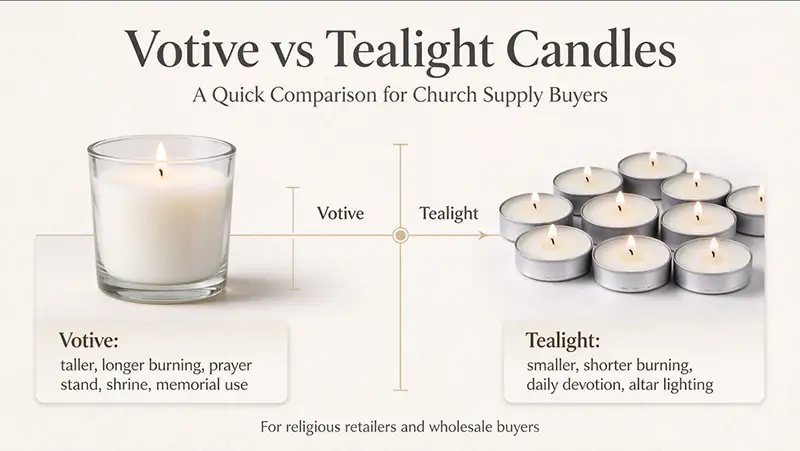
A votive candle is a short, cylindrical candle — traditionally about 38 mm (1.5 in) in diameter and 50 mm (2 in) tall — designed to be burned inside a holder. The name comes from the Latin votum, a vow or promise: these are the candles a worshipper lights as a petition or in thanksgiving.
The defining engineering detail is the wax blend. Votive wax is formulated to melt completely across the surface and fill the holder, turning the glass cup itself into the candle’s mold. That’s why a votive without a holder is not a smaller candle — it’s a wax spill waiting to happen.
Tealight Candles
A tealight (also written tea light, tealight, TL) is a self-contained candle in a thin aluminum cup, typically 38 mm (1.5 in) across and only 12–19 mm (0.5–0.75 in) deep. It was originally designed to keep a teapot warm — hence the name — and it is the workhorse of the modern candle market: restaurants, hotels, spas, and increasingly church votive stands.
Because the aluminum cup holds the melting wax, a tealight needs no separate holder to function. It still benefits from one for heat protection and presentation, but functionally it is complete as sold.
The Category Nobody Asks About — Until It’s a Complaint
Don’t confuse either with the 7-day votive / novena candle (a tall glass-encased candle burning 5–7 days) or the sanctuary lamp refill. All four live in the same catalogue section and all four are frequently mis-ordered by new buyers. If a customer asks for “votives for our stands” and you ship novena candles, you’ve just lost a parish account.
2. Side-by-Side: The Spec Table Buyers Should Keep
| Specification | Votive Candle | Tealight Candle |
|---|---|---|
| Typical dimensions | 38 mm dia. × 50 mm H (1.5 × 2 in) | 38 mm dia. × 12–19 mm H (1.5 × 0.5–0.75 in) |
| Wax volume (approx.) | 35–45 g | 10–16 g |
| Standard burn time | 4–6 hours (extended-burn versions 7–9 h) | 3–4 hours (standard); 6–8 h in “long-burn” or church grades |
| Container | None — sold bare, requires a holder | Aluminum cup included, self-standing |
| Wax behavior | Melts to a full liquid pool; holder acts as mold | Melts within the cup; cup contains the pool |
| Common wax | Paraffin–stearin blend, hard wax; soy versions available | Paraffin (majority), soy or palm blends for premium lines |
| Wick | Cotton, often self-trimming; some cotton-core | Short cotton wick, sometimes paper-core for steady low flame |
| Typical case pack | 12 / 24 / 48 per inner box; often 144–288 per carton | 50 / 100 per poly bag; 500–1,000 per carton |
| Unit cost (indicative) | Higher per piece (2–5× tealight) | Lowest cost per light in the category |
| Breakage risk | Wax chips and warping in heat; no glass in transit | Cups dent easily; wax shifts if cartons are stored on their side |
| Primary buyers | Churches, funeral homes, wedding planners, gift shops | Churches (votive stands), hotels, restaurants, event rentals, retail multipacks |
3. The Holder Rule — the Difference That Causes Most Returns
This is the single most important thing to communicate to a buyer: a votive is not a finished product until it’s in a holder. A tealight is.
- Votive: the wax is designed to liquefy edge to edge. Without a snug glass or metal cup, the pool runs onto the surface below — a stain, a fire risk, and a ruined altar cloth. It also burns faster and unevenly in open air.
- Tealight: the aluminum cup is the vessel. Placing it directly on a heat-safe surface works; a glass or metal holder is still recommended for churches with wooden furniture and for visual consistency in stands.
- Cross-selling implication: every votive SKU has a natural attachment — the holder. Every tealight SKU has an attachment too — the stand or holder insert. Lead with the pairing and your average order value rises; lead with the candle alone and you’ll field “it melted everywhere” claims.
4. Burn Time Is Not a Marketing Number — It’s Wax Volume
Buyers compare “4 hours vs 4 hours” and assume the products are equivalent. They are not. Burn time is driven by grams of wax ÷ burn rate, and the two products sit at very different points on that curve.
- A standard votive carries roughly three times the wax of a standard tealight, which is why it runs 4–6 hours while a basic tealight runs 3–4.
- Church-grade tealights are the exception worth stocking: taller cups (19 mm) and denser wax push them to 6–8 hours, which is what a parish actually needs for a full day of votive-stand use or an all-day exposition.
- Published burn times assume still air and no draft. A stand by an open church door can cut burn time by a third. Quote a range, not a single figure — it protects you from claims.
5. How Religious Buyers Actually Use Each One
Votive Candles
- Votive stands in the church entry or side chapel — the classic petition/thanksgiving use, lit for a few minutes to a few hours.
- Funeral and memorial services — often paired with printed cards; funeral homes reorder continuously, year-round.
- Weddings and baptisms — unity candles, aisle arrangements, guest-blessing stations.
- Retail devotionals — shrine gift shops sell votives in decorative glass with saints’ images, at healthy margins.
Tealight Candles
- Votive stands with tealight inserts — many modern parishes have converted to tealights because they’re clean, uniform, and require no scraping of spent wax.
- Adoration and prayer vigils — long-burn tealights keep a continuous flame without staff attention.
- Hospitality and events — hotels, restaurants, banquet halls, and candlelit carol services.
- Multipack retail — 50- and 100-count bags are an impulse SKU in general merchandise and home décor.
The seasonal pattern matters for planning: demand for both spikes around All Saints’ and All Souls’ Day (early November) — the single largest memorial-candle window in many markets — then again at Christmas and Easter, with funerals providing steady baseline volume the rest of the year.
6. Cost, Packing and Freight: Where the Real Margin Lives
- Cost per light, not cost per case. Tealights win on unit economics by a wide margin; votives win on perceived value and basket size (holder + candle + gift box). Stock both, position them differently.
- Cube and weight: tealights are dense and low-profile — cheap per cubic meter, heavy per carton. Votives are lighter but bulkier. Mixed pallets should be built on weight for tealights and volume for votives.
- Transit damage: votive wax chips and warps in summer containers; specify shrink-wrap on inner boxes and avoid top-loading. Tealight cups dent — insist on cartons stored upright, never on their side, or candles arrive oval.
- Storage at the buyer’s end: both need cool, dry conditions below roughly 25°C. Votives left in a hot warehouse bend and won’t sit in holders; tealights left in sunlight yellow and the wicks soften.
7. Compliance and Labeling — Don’t Skip This Section
Candles are regulated consumer products, and religious buyers increasingly audit their suppliers. Before quoting, confirm with your compliance team:
- EU: candle safety labelling under EN 15494 (safety phrases and pictograms), plus the General Product Safety Regulation (EU) 2023/988 — which requires an identified responsible economic operator in the EU on the product or packaging.
- US: ASTM F2417 is the standard specification for candle fire safety; buyers increasingly ask for test reports, not just a certificate of conformity.
- Materials: fragrance and dye declarations for scented lines; lead-free wick statements (self-evident in most markets now, but still requested in RFQs).
- Documentation pack: spec sheet, SDS where applicable, burn-time test data, carton dimensions and gross weight, HS code (usually 3406.00 for candles), and country of origin.
8. A Buyer’s Checklist: Ten Fields That End the Confusion
Put these ten fields on every quotation and the votive/tealight mix-up disappears from your inbox:
- Product type stated in words, not just a SKU code (votive / tealight / novena / pillar)
- Diameter and height in millimetres and inches
- Wax weight in grams
- Tested burn time as a range, with test conditions
- Whether a holder is required (yes/no — spell it out)
- Wax type and wick type
- Color options and whether they’re dyed-through or dipped
- Inner pack and carton quantities, carton cube and gross weight
- Compliance markings and available test reports
- MOQ, lead time, and whether mixed-SKU cartons are allowed
9. Five Mistakes That Generate Returns
- Selling votives as “no-holder-needed.” They will melt across the altar rail. Always specify the holder.
- Assuming all tealights are 4-hour. Standard, 6-hour, and 8-hour grades are different products at different prices — quote the grade.
- Shipping tealights in side-stacked cartons. The cups deform and the wicks lean; the buyer rejects the lot.
- Treating novena candles as “large votives.” Different burn, different glass, different price point — and a different buyer expectation.
- Quoting a single burn-time figure. Drafts and drafts alone can cut 30% off the number. Always quote a tested range.
The Bottom Line
| If the buyer says… | They probably mean… | Quote this |
|---|---|---|
| “Small candles for our prayer stand” | Votives in glass cups, or tealights in inserts | Ask which stand they have; quote both, with holders |
| “Cheapest candles for the stands” | Standard tealights (budget) or church-grade (long day) | Tealight 50/100-count, and 8-hour grade as an upsell |
| “Candles for a funeral service” | Votives, often with cards or glass holders | Votive + holder bundle, 144-count cartons |
| “Candles that burn all day” | Long-burn tealights or novena candles | 8-hour tealights for stands; novena for 5–7 day burn |
| “Assorted small candles for the shop” | Mixed retail multipacks | Tealight multipacks + decorative votive gift sets |
Votive and tealight are not competitors — they’re two different answers to two different questions. The votive asks, “Will you give this moment your full attention?” The tealight asks, “Can we keep a light burning, reliably, for hours?” A wholesaler who can explain that distinction in one sentence wins the account. One who can put the specs on paper keeps it.
Sources & Further Reading
- EN 15494:2019 — Candles, Product safety labels
- Regulation (EU) 2023/988 — General Product Safety Regulation (GPSR), applicable from 13 December 2024
- ASTM F2417 — Standard Specification for Fire Safety for Candles
- National Candle Association — technical guidance on burn testing and wax performance
Disclaimer: Specifications and compliance requirements vary by manufacturer, market, and product line. Figures given here are typical industry ranges for orientation only — always confirm with your factory’s test reports and your compliance advisor before quoting.


