


Blog
Altar Candle Sizes Chart: Diameter, Height & Burn Times

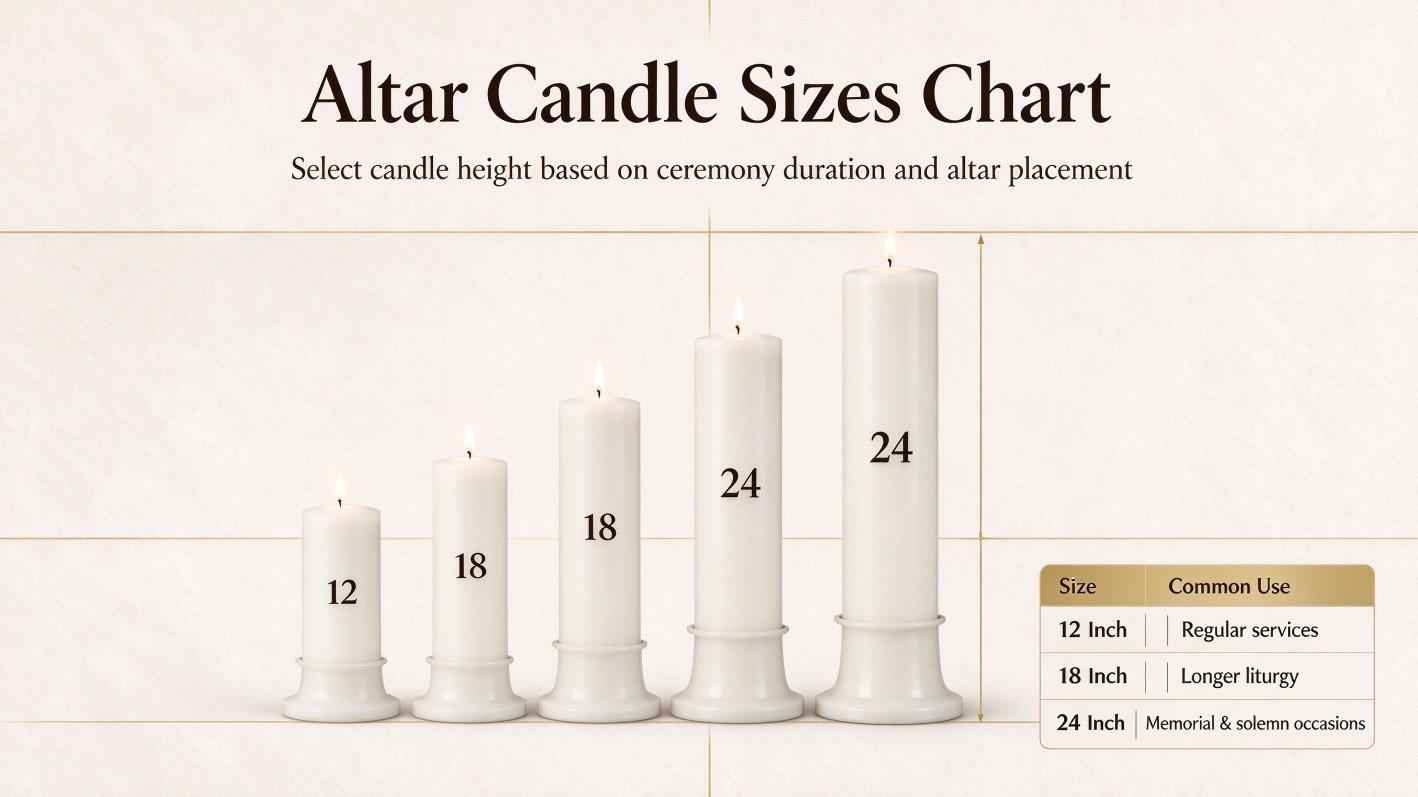
Most church altar candles use one of five standard diameters: 7/8″, 1-1/2″, 1-7/8″, 2″ and 3″. Diameter is decided by your candlestick socket — not by preference — and it is the single measurement that determines whether a candle burns cleanly or drips all over the altar. Height comes second: it sets how many hours of service you get between replacements. The charts below give you the full altar candle sizes reference, typical burn times by size, the 51% vs 100% beeswax decision, and a simple way to calculate your parish’s annual consumption before you order.
Altar Candle Sizes Chart: Diameter × Height × Burn Time
Two measurements define an altar candle: diameter (must match the socket or follower) and height (sets service hours). The table lists the sizes used by most Catholic, Anglican and Lutheran parishes, with typical burn times for 51% beeswax candles burning in still air with a follower.
| Diameter | Common Heights | Typical Burn Time | Typical Use |
|---|---|---|---|
| 7/8″ (22 mm) | 8-1/2″ – 12-3/4″ | 8 – 14 hrs | Side altars, chapels, devotional stands, home altars |
| 1-1/8″ (29 mm) | 12″ – 16″ | 18 – 28 hrs | Smaller parish candlesticks, Advent wreaths |
| 1-1/2″ (38 mm) | 12″ – 26″ | 35 – 80 hrs | The parish workhorse size — most common altar socket |
| 1-7/8″ (48 mm) | 16″ – 26″ | 60 – 110 hrs | Larger parish altars, longer replacement cycles |
| 2″ (51 mm) | 16″ – 24″ | 68 – 100 hrs | Main altars where a wider candle is wanted |
| 2-1/2″ – 3″ (64–76 mm) | 12″ – 24″ | 100 – 160+ hrs | Cathedrals, high altars, solemn liturgies |
A quick rule of thumb behind the numbers: burn time scales roughly with the square of the diameter and linearly with height. A 1-1/2″ candle burns about twice as long per inch as a 7/8″ candle of the same height, because the wider candle feeds a proportionally larger wax pool to the flame. That is why doubling height on a thin taper adds few hours, while stepping up one diameter size adds many.
How to measure your existing altar candles
- Measure the inside diameter of the socket (or the follower opening) — not the outside of the old candle, which shrinks as it burns down.
- Measure candle height from base to top, and note any clearance limits above the altar (reredos, canopy, flowers).
- Check the base type: plain end (PE) for exact-fit sockets, or self-fitting end (SFE) with a tapered base that seats in slightly varied sockets.
- If your fixtures came from different suppliers over the years, measure each candlestick separately and label the sets — mixed churches are the norm, not the exception.
51% vs 100% Beeswax Altar Candles: What Changes
In the US church-supply market, 51% beeswax is the long-standing standard for altar candles: enough beeswax for the slow, clean, honey-toned burn churches expect, at a price that makes weekly replacement affordable. 100% beeswax burns longer and cleaner still, holds deeper color, and is the usual choice for Orthodox churches, high-demand sanctuaries and parishes that want an all-natural fuel.
| Factor | 51% Beeswax | 100% Beeswax |
|---|---|---|
| Burn time (same size) | Baseline | Approx. 10–20% longer |
| Flame & smoke | Clean, steady | Cleanest, brighter flame |
| Scent | Light honey note | Distinct natural honey |
| Cost per candle | Lower | Higher (pure material cost) |
| Typical buyer | Parish weekly stock, budget cycles | Orthodox churches, sanctuary lamps, premium orders |
| MOQ friendliness | Wide size range in stock | Best value at bulk quantities |
For wholesale buyers the practical difference shows up in reorder economics: 51% beeswax keeps unit cost low for weekly parish consumption, while 100% beeswax reduces replacement frequency and suits fixed sanctuaries where the candle must not be changed often. Both share the same diameter system, so switching wax percentage never changes your sockets or followers.
Matching Followers, Sockets and Candle Ends
A candle follower (the brass cap that rides down the candle) only works if its opening matches the candle diameter exactly: a 1-1/2″ candle takes a 1-1/2″ follower. Too loose and it slides open, breaking the wax seal; too tight and it binds on the candle. Ordering note that saves a lot of after-sales emails: “altar candle” is not an orderable specification — diameter and base type are. Put the diameter, height, wax percentage and end type (SFE or plain) on every purchase order.
- Plain end (PE) — straight base for sockets made to that exact diameter.
- Self-fitting end (SFE) — tapered base, seats securely across a range of socket sizes; the safer choice when you cannot verify every socket.
- Follower users — confirm the follower opening, not just the socket, before switching suppliers. Supplier-to-supplier diameter tolerance differences are the #1 cause of dripping complaints.
How Long Do Altar Candles Burn? Working Out Replacement Cycles
For procurement, burn time is really a replacement-cycle question. Three quick scenarios using the chart above:
- Daily Mass parish, 1-1/2″ × 16″ (approx. 47 hrs): two candles on the altar, roughly 4–5 services a week → each pair lasts about 2 weeks → around 26 pairs per year.
- Weekly-only chapel, 7/8″ × 12-3/4″ (approx. 13 hrs): one candle per service → about 52–60 candles per year.
- Sanctuary lamp, 7-day glass candle: continuous burning → replace weekly → 52 units per year, plus seasonal peaks at Easter and Christmas.
Add 10–15% for feast days, weddings and funerals, then align the total with the factory MOQ so you order in full cases rather than piecemeal. Most parishes settle on a quarterly or biannual bulk order once they see the annual number — it also locks in pricing before peak seasons.
Seasonal Sizes: Paschal and Advent Candles on the Same Altar
Two church seasons temporarily change the size picture. The Paschal (Easter) candle is the largest candle on the altar — typically 2″ to 3″ in diameter and 36″ to 48″ tall, decorated with wax-relief crosses, alpha-omega bands and the year digits. It stands from the Easter Vigil through Ascension, then moves beside the baptismal font for the rest of the year, so its diameter must suit a separate stand. Advent wreath candles follow the opposite logic: four small candles (often 7/8″ or 1-1/8″ taper sizes) in the parish’s liturgical colors — three violet, one rose. If you order seasonal stock annually, the efficient pattern is one bulk order that covers Paschal, Advent and ordinary-time candles together, timed to arrive 6–8 weeks before Advent.
The Four Most Common Altar Candle Ordering Mistakes
These are the repeat after-sales cases we see from wholesale buyers — each one is avoidable at the purchase-order stage:
- Ordering by height first. Buyers pick a dramatic 26″ candle, then discover it does not fit a 1-1/8″ socket. Diameter decides fit; height only decides hours. Measure the socket before the catalog.
- Ignoring the follower opening. The follower, not the socket, is the running surface. A correct candle in a mismatched follower still floods and drips — and gets blamed on the wax.
- Under-counting feast days. Annual totals built on Sunday Masses only miss roughly 10–15% of real consumption (weddings, funerals, Holy Week, First Communions). Build the buffer into the case quantity.
- Mixing suppliers’ tolerances. Diameter tolerances differ between factories. Switching suppliers mid-year with a “1-1/2″” assumption can introduce wobble in sockets that were tight before. Re-measure one socket after any supplier change.
Altar Candle Sizes: Quick Answers
What is the most common altar candle size? The 1-1/2″ diameter dominates parish altars — it fits the standard candlestick socket used by most Catholic and Anglican churches, with heights from 12″ to 26″ covering both frequent and extended replacement cycles.
How tall should altar candles be? On a parish altar, candles of 16″ to 24″ give good visibility without hiding the crucifix. Cathedral and high-altar settings run taller (up to 48″) and pair with the larger 2″–3″ diameters. Height is a proportion decision — diameter remains the fit decision.
What size are Catholic altar candles specifically? Catholic altars most often use 1-1/2″ candles in 51% beeswax for weekly stock, a 2″–3″ Paschal candle for Easter, and 7-day sanctuary candles in glass for the sanctuary lamp. Orthodox parishes typically move the whole altar line to 100% beeswax.
Can I mix 51% and 100% beeswax candles on the same altar? Yes — both burn on the same wick system and share identical diameters, so sockets and followers are unaffected. The usual pattern is 100% beeswax for the sanctuary lamp and Paschal candle, 51% for the candles replaced weekly.
EU Buyers: Anti-Dumping Duty Changes the Sourcing Math
Since the EU anti-dumping measures on candle imports, the landed cost of EU-bound altar candles depends heavily on the supplier’s documentation, HS classification and duty handling. Buyers sourcing for European church-supply chains should compare suppliers on delivered duty-paid cost per candle, not FOB price, and ask specifically how anti-dumping duty is treated in the quotation. A factory that quotes transparently on this point is worth several percentage points of margin per order. (Confirm current applicable rates with your customs broker before publishing decisions based on this section.)
Wholesale Altar Candles: Ordering From the Factory
All diameters in this guide are produced in-house in both 51% and 100% beeswax, with plain and self-fitting ends, at factory MOQ from 500 pcs per size. Browse the wholesale altar candles category for the full liturgical range, or go straight to three core lines: white church pillar candles for altar use, ivory traditional beeswax altar candles, and beeswax altar pillar candles for church wholesale.
For candle buyers comparing waxes across the whole devotional range, the prayer candle buying guide covers votive, vigil and novena formats alongside the altar lines above.


