



Blog
7-Day Candles vs 9-Day Candles: Usage Differences, Best Sellers and Bundle Strategies for Wholesale Buyers

Same Glass Jar Family — Different Prayers, Different Buyers
Walk down the devotional aisle of any Catholic supply wholesaler in the Americas and you’ll see two tall glass-jar candles sitting side by side: the 7-day candle and the 9-day candle. To a new buyer they look like the same product in different sizes. To the parishes, botánicas, funeral homes and spiritual shops that reorder every month, they are two different tools for two different devotional lives.
Getting the distinction right matters commercially: stock the wrong mix and you’ll either run out of your volume driver in week two, or sit on slow-moving glass for a year. This guide covers how the two candles differ in actual use, which one sells better from a wholesale perspective, and how to bundle them so both keep moving.
1. What Each One Actually Is
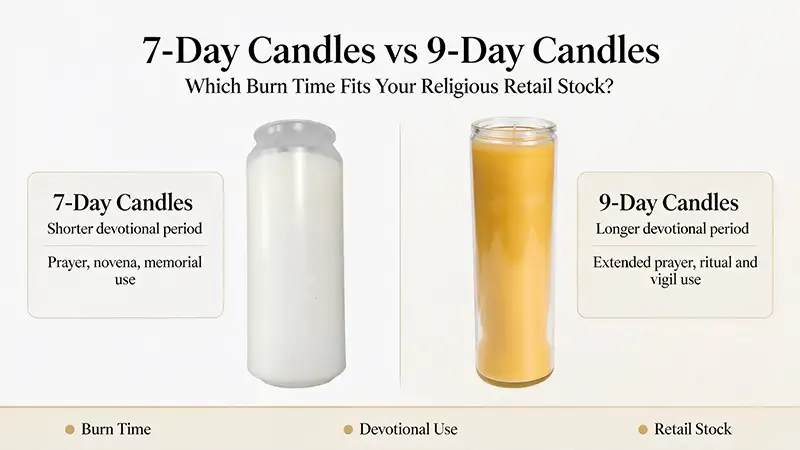
Both are glass-encased devotional candles — a cotton wick set in wax inside a tall printed glass cylinder, designed to burn for days without attention. The difference is duration, and duration drives everything else: jar height, wax load, price point, and devotional purpose.
| Specification | 7-Day Candle | 9-Day Candle |
|---|---|---|
| Jar size (typical) | ~57 mm dia. × 205 mm H (2.25 × 8 in) | ~63–70 mm dia. × 230–255 mm H (2.5–2.75 × 9–10 in) |
| Wax load (approx.) | 400–500 g | 550–700 g |
| Tested burn time | 120–170 hours (~5–7 days) | 180–216 hours (~8–9 days) |
| Typical carton | 12 / 24 per carton | 12 per carton (taller, heavier) |
| Design language | Saint images, intentions (health, money, love, protection), plain colored wax | Novena dedications (Our Lady, Holy Spirit, patron saints), often with prayer text on the glass |
| Price positioning | Entry price — the volume driver | Higher unit price and better per-unit margin |
| Cultural footprint | Catholic mainstream + folk practice (botánicas, hoodoo, santería traditions) | Strong in Hispanic/Latino devotional market (veladoras), novena-cycle parishes |
One caution for quotations: a “9-day” label is a devotional claim, not a physics guarantee. If the buyer lights it indoors at 20°C with no draft, nine days is realistic; in a drafty vestibule, expect less. Quote tested hours, not just the name on the glass.
2. Usage Scenarios: Where Each Candle Actually Gets Burned
The 7-Day Candle: The Weekly Devotion Workhorse
- Personal intentions: one candle per petition — health, work, family, protection. The “burn one candle for your intention this week” habit is the single largest use case, and it repeats every week, which is why 7-day volume dwarfs everything else in the category.
- Home altars and shrines: the default candle for the home devotional corner across Catholic Latin America and the US Latino market.
- Devotional days: Tuesday candles for Saint Jude, Wednesday for Saint Joseph, Saturday for Our Lady — weekly rhythms create weekly reorders.
- Folk and spiritual supply channels: botánicas and spiritual shops burn 7-day candles for cleansing, prosperity and protection work — demand that is year-round and largely independent of the Church calendar.
- Memorial use: one-week mourning candles after a funeral, and anniversary remembrances.
The 9-Day Candle: The Novena-Cycle Specialist
The 9-day candle exists for one structural reason: a novena is nine days of prayer. Catholic tradition runs novenas as fixed cycles — nine days of prayers before a feast, for a deceased loved one, or in preparation for a grace. A 9-day candle is built to span the entire cycle with a single flame.
- Formal novenas: Christmas novena (Dec 16–24), the Pentecost novena (nine days before the feast), the Novena of Grace (Mar 4–12), Our Lady of Guadalupe novena (Dec 3–12) — each one a predictable, calendar-driven spike in 9-day demand.
- Funerals and mourning: in Hispanic tradition, the novenario — nine days of prayers for the deceased — is marked with a candle meant to last the whole period. Funeral homes and funeral-supply buyers are the steadiest 9-day accounts.
- Parish novena programs: parishes running a nine-night devotional series buy in blocks — often 50–200 jars for one event, which makes 9-day sales spiky but large.
- Special petitions: nine-day candles for major life intentions (a difficult surgery, a legal case, a child’s exam season) — fewer buyers, deeper need, less price sensitivity.
The practical summary: the 7-day candle serves a weekly rhythm; the 9-day candle serves a nine-day event. Rhythms reorder automatically — events have to be planned for.
3. Which One Sells Better? Volume vs Margin vs Predictability
| Dimension | 7-Day Candle | 9-Day Candle |
|---|---|---|
| Units moved | Winner — typically 3–5× the unit volume of 9-day in mixed devotional assortments | Niche but deep in Latino markets and funeral channels |
| Revenue per unit | Lower | Winner — higher jar price, better per-unit margin |
| Order frequency | Weekly/monthly rhythm — highly repeatable | Event-driven spikes around novena seasons and funerals |
| Demand predictability | High and flat, with modest seasonal lift | Low and lumpy — big wins if you hit the calendar |
| Inventory risk | Low (always moves) | Moderate (missed novena date = stock until next year) |
| Freight efficiency | Better cube-to-value; lighter jars | Heavier, taller jars; more breakage exposure per pallet |
The verdict for most wholesalers: the 7-day candle is your volume and cash-flow engine — it should anchor the assortment and reorder automatically. The 9-day candle is your margin and event engine — fewer units, higher price, and outsized sales when the devotional calendar says so. A proven starting ratio for a mixed religious-goods assortment is roughly 3:1 or 4:1 (7-day : 9-day) in units, adjusted up for Latino-market-heavy territories and funeral-home accounts.
Two refinements worth testing: funeral channels often convert better on 9-day (the novenario is a hard requirement, not a preference), while botánica and gift-shop channels convert better on 7-day multipacks. Your ratio should follow your account mix, not a universal number.
4. Five Bundle Strategies That Move Both SKUs
Bundle 1: The Novena Kit (9-Day Anchor)
One 9-day candle + a printed novena prayer booklet for the matching devotion (Guadalupe, Christmas, Pentecost, Novena of Grace). Sold 4–6 weeks before each novena window. This is the single most effective way to convert 9-day stock into planned, pre-paid seasonal orders instead of hoping someone walks in on December 3rd.
Bundle 2: The Funeral & Mourning Pack (Funeral Channel)
One 9-day candle + one 7-day candle + a remembrance card, packed flat for funeral homes and memorial shops. The funeral director stocks one SKU and can serve both the novenario (nine days) and the week-after follow-up visit.
Bundle 3: The Home Altar Starter Set (Retail & Gift Channel)
Two 7-day candles (a saint + a plain intention jar) + one 9-day candle + a small holder tray. Positioned as “everything for your first home altar” — strong in gift shops around Easter, Mother’s Day and Christmas, and it introduces new customers to the higher-price 9-day format.
Bundle 4: The Devotional Week Pack (Volume Multiplier)
Four 7-day candles at a small discount — one intention per week for a month. Pure 7-day volume play; it converts single-jar buyers into monthly-repeat buyers and smooths your reorder curve.
Bundle 5: The Saint Series Mixed Carton (Assortment Play)
A 12-jar mixed carton — e.g., 8× 7-day designs + 4× 9-day novena dedications — sold to small retailers who can’t forecast SKU-level demand. One carton, full shelf, both formats introduced at once. Mixed cartons also cut your MOQ barrier for new accounts.
Cross-merchandising note: both formats pair naturally with drip-catcher caps, glass plate holders, snuffers and prayer cards. If you only bundle candles with candles, you’re leaving the attachment basket on the table.
5. Buying and Stocking Tips Specific to Glass-Jar Candles
- Glass is the risk. Insist on individual cartons with cell dividers, jars packed upright, and cartons marked “this way up.” Jar-on-jar stacking without dividers is the top cause of transit claims in this category.
- Print quality sells the candle. In this category the label is the product — buyers choose Saint Jude over plain wax. Check printing for fade resistance; direct sunlight on a store shelf will bleach cheap prints within weeks.
- Burn-time honesty: quote tested hours (with draft-free conditions noted). A jar that dies on day five of a nine-day novena generates complaints you can’t answer.
- Wick maintenance matters at this scale: a 9-day flame burning for 200 hours needs a wick that doesn’t drown. Ask the factory for their wick specification and any customer burn-test data.
- Timing the calendar: for 9-day stock, orders must land 4–6 weeks before each novena window — before the Guadalupe and Christmas novenas (early December), Pentecost (late spring), and the Novena of Grace (March). For 7-day stock, keep a flat monthly flow and scale up before Easter and Christmas.
- Storage: same rules as all wax — cool, dry, below ~25°C, out of sunlight, cartons upright. Glass jars also hate thermal shock: never store cold jars near heaters or move them from a cold truck to a hot stockroom and open immediately.
The Bottom Line
| Question | Quick Answer |
|---|---|
| Core usage difference? | 7-day = weekly personal devotion and folk-practice rhythm; 9-day = formal nine-day novenas, novenario mourning, parish programs |
| Which sells more? | 7-day on units (3–5× volume, always moves); 9-day on margin and event spikes |
| Stocking ratio? | Start at 3:1 or 4:1 (7-day : 9-day); shift toward 9-day for funeral and Latino-market accounts |
| Best bundles? | Novena kit (pre-season), funeral pack, home altar starter set, 4-jar weekly pack, saint-series mixed carton |
| Timing rule? | Land 9-day stock 4–6 weeks before each novena window; keep 7-day flow flat and steady |
The two candles aren’t rivals on the shelf — they’re two clocks. The 7-day candle ticks with the weekly rhythm of ordinary prayer; the 9-day candle ticks with the great set-piece novenas of the Church year and the nine days families spend saying goodbye. Stock both, bundle them deliberately, and let each clock run on its own schedule.
Sources & Further Reading
- Catholic novena calendar — Christmas novena (Dec 16–24), Novena of Grace (Mar 4–12), Pentecost novena, Our Lady of Guadalupe novena (Dec 3–12)
- Hispanic devotional tradition — the novenario nine-day mourning custom and the veladora market
- National Candle Association — burn testing and wax performance guidance
- EN 15494 / ASTM F2417 — candle safety labelling and fire-safety specifications (see our votive vs tealight guide for the full compliance checklist)
Disclaimer: Burn times, jar dimensions and sales ratios are typical industry figures for orientation only. Actual performance varies by factory, wax formulation and climate — always confirm with burn-test reports and your own sales history before committing to a ratio.


