




Blog
How to Test Sealing Wax Quality Before Large Wholesale Orders

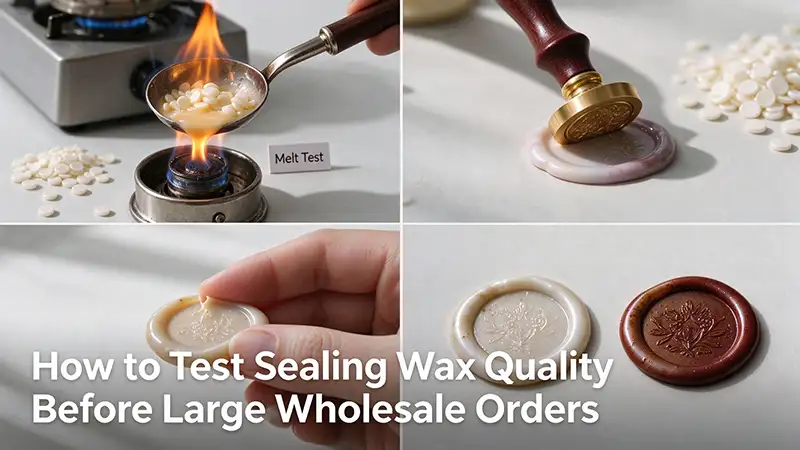
Short answer: run a six-point sample protocol before you commit — melt behavior, stamp detail, crack resistance, adhesion, thermal stability and batch consistency. A day of testing on 2-3 kg of samples will catch the defects that ruin production runs: wax that bubbles on the pour, sticks to the stamp, cracks at the edges after curing, or drifts in color between lots. The most expensive sealing wax is the one you have to reject after it arrives.
This guide is written for buyers placing wholesale orders — stationery distributors, wedding-goods wholesalers, packaging converters and retail brands. Every test below can be done with a spoon, a tea light, your actual stamp and your actual packaging substrate; no lab equipment required. All thresholds are practical industry ranges — confirm tolerances against your own spec sheet before writing them into a purchase contract.
Why Sampling Beats Trusting a Spec Sheet
Sealing wax fails in ways a product photo will never show: bubbles in the melt, stringing off the spoon, a stamp that pulls instead of releasing, hairline cracks a week after the seal sets, color that shifts one lot to the next. These are formulation problems — wax blend, resin ratio, pigment dispersion — and they only reveal themselves when you actually melt, pour, stamp and age the product.
The economics are brutal at scale. A 500 kg order that cracks in transit is not a discount negotiation; it is a returned container, a missed season, and a stationery brand that quietly stops reordering. Sampling costs you a few kilograms and one working day. Every serious wax supplier offers samples precisely because they know this — see our sample policy for how we handle it: free pre-production samples, courier cost collect.
The Six-Point Test Protocol
| # | Test | Method | Pass criteria |
|---|---|---|---|
| 1 | Melt behavior | Melt 20-30 g in a spoon or furnace | Flows like warm honey in 4-6 min; no clumps, no stringing, no color separation |
| 2 | Stamp detail | Pour, wait ~5 s, press stamp 3-5 s | Fine lines reproduce cleanly; stamp releases without pulling |
| 3 | Crack resistance | After 24 h cure, peel seal off and bend ~30° | Bends or tears ductile; does not snap into pieces |
| 4 | Adhesion | Seal on your real substrate; peel after 24 h | On paper: tears fibers. On glass/capsule: stays bonded |
| 5 | Thermal stability | Store sealed samples in a hot environment (~40 °C) for a day | No sticking to packaging, no surface sweating, no deformation |
| 6 | Batch consistency | Compare samples from two production lots side by side | Color and melt behavior indistinguishable |
Run the six tests on every format you plan to order — beads, wick sticks and glue-gun rods behave differently even from the same formulation. The sections below explain what each test actually tells you.
Tests 1-2: Melt Behavior and Stamp Detail
Melt behavior is the first gate because every downstream defect starts here. Melt a working quantity in a spoon over a tea light, or in a furnace if you will produce that way (a dedicated wax furnace keeps the pool at constant temperature, which is what production will look like). Good wax flows smoothly with a glossy surface. Walk away if you see: granules that refuse to melt even at working temperature, strands that string from the spoon to the seal (binders too high), or pigment settling to the bottom leaving a pale top layer (dispersion failure — your color will drift across a run).
Stamp detail decides whether your product looks premium or handmade-in-the-wrong-way. Pour a seal, wait about five seconds, press with even pressure for 3-5 seconds and lift straight up. Check two things: that fine lines in your stamp design actually reproduce (soft, low-detail waxes blur monograms and small logos), and that the stamp releases cleanly. Wax that pulls back with the stamp is either too hot or has the wrong tack for your stamp material — note which, because the fix differs.
Tests 3-4: Crack Resistance and Adhesion
Crack resistance is the single most important property for anything that ships. After a seal has fully cured — give it 24 hours, not 10 minutes — peel it off the substrate and bend it gently. Envelope wax is *supposed* to be brittle (that satisfying snap), so for stationery runs a clean break is acceptable. For wine bottles, gift boxes and anything couriered, you want flexible formulation that bends or tears instead of shattering. Our bottle-grade flexible wax exists precisely because standard formulations crack on glass; ask which grade you are sampling.
Adhesion must be tested on *your* substrate, because that is where the seal lives. Coated art paper, textured cotton paper, glass and foil capsules all interact differently with the same wax. The pass criteria differ by surface: on paper, a properly adhered seal tears paper fibers when peeled — if it lifts off in one clean disc, adhesion failed. On glass and capsules, the seal should stay bonded after 24 hours and peel with effort. If your product line includes bottles, test on the actual bottle, not on flat glass.
Tests 5-6: Thermal Stability and Batch Consistency
Thermal stability catches the failure that appears between your warehouse and your customer. Sticks soften and bend above roughly 35-40 °C — a delivery van in summer will do that in an hour. Put a handful of sealed samples (and a few raw sticks) somewhere hot — a closed car, a sunlit windowsill — for a day. Pass: seals keep their shape, no wax blooming or sweating on the surface, sticks stay straight. Fail: seals stick to each other or to packaging inserts. If your stock sits in non-climate-controlled space, beads are the safer inventory format than sticks — they cannot deform.
Batch consistency is the test most buyers skip and most regret. Ask the supplier to pull your sample from a current production lot, then when you reorder, check the new lot against the approved sample side by side under daylight. Wax color drifts between production runs when pigment dispersion is loose — and for stationery brands doing a reprinted invitation suite six months later, a half-shade drift is a complaint. The fix is contractual: lock a master sample at order time, and make color matching against it part of the PO. We hold master samples for exactly this reason on custom colors.
Red Flags: Reject the Sample If You See These
- Bubbles on the pour that do not pop before stamping — moisture in the formulation; will get worse in humid climates
- Soot residue from wick sticks landing on pale paper or boxes — carbon will not wash off cotton stationery
- Edge cracks within an hour of stamping on non-flex grades being sold to you as flexible
- Wax sticking to the stamp across three consecutive seals after the stamp is up to temperature
- Oily sheen or sweating on cured seals — excess softener; it will mark packaging in a hot container
- Yield surprises: weigh 100 beads and do the math — if 1 kg produces far fewer seals than the quoted count, your landed cost per seal is quietly higher. A 25 mm seal at ~2.5 g gives roughly 350-400 seals per kg
What to Ask the Supplier Before the PO
- Data basics: recommended melt temperature range, grams per seal at your stamp diameter, and shelf-life/storage conditions
- Compliance: food-safe documentation if seals sit above corks or food contact areas; REACH/EN71 if your market needs it
- Grades: which formulation is brittle (envelope) vs flexible (bottle/gift) — do not let them be conflated
- Master sample retention: confirm the supplier keeps the approved sample and matches production lots to it
- Trial MOQ: mixed-color and small-quantity trial orders before a full run — we accept loose bead trials from 5 kg and stick trials by design
- Custom color process: Pantone matching, pressed-sample approval, and the MOQ per color (our sealing wax and kits range runs custom colors from MOQ 500 pieces)
Test Notes by Format
Beads are the easiest format to test — one melt gives you dozens of pours, and yield math is straightforward. Wick sticks need the soot check (built-in-wick sticks and 14 cm round bars behave differently: wicks drip hotter, so also check for scorch marks on light paper). Glue-gun rods need one extra step: run them through the actual gun model your customers or your line will use, because a rod that feeds unevenly in a cheap gun is a retail complaint generator. For retail sets — the kind in our 24-color beginner set — also check color-to-color consistency across the whole assortment, not just one color.
How We Support Sample Testing
TaBo is a 14-year candle and craft-accessory manufacturer with a 20,000 m² facility, BSCI and ISO9001 certification, supplying sealing wax in 40+ countries. Before any wholesale commitment we ship free pre-production samples — beads, sticks or rods, standard or custom colors — so you can run the six-point protocol on your own substrates and with your own stamps. Courier cost is collect; see the full sample policy.
The sequence we recommend: send us your stamp diameter, target substrate and monthly volume → we ship matched samples in both brittle and flexible grades → you test → we lock a master sample with your PO. From there, every reorder is matched against what you approved, not against a photo.
Ready to test? Browse the full sealing wax range or send us your spec — samples go out within days, not weeks.
FAQ
-
How many samples should I test before a wholesale order?
Two to three kilograms covers the six-point protocol with margin for repeats: enough for 30+ pours, bend and peel tests, a thermal-stability batch, and side-by-side comparison against a second lot if the supplier will provide one.
-
What is the most common sealing wax defect?
Crack failure on shipping — brittle formulation sold or specified where a flexible grade was needed. The second most common is batch color drift on reorders. Both are caught by the bend test and the two-lot comparison.
-
Can I test sealing wax quality without special equipment?
Yes. Every test in the protocol uses a spoon or furnace, a tea light, your stamp, your actual packaging substrate and a warm room. A kitchen thermometer helps for melt temperature, but flow behavior by eye is sufficient for screening.
-
How do I check sealing wax color consistency between batches?
Place seals from the old and new lot side by side under daylight (not warm indoor lighting) and check the poured surface, not the raw bead — pigment can look uniform in bead form and still pour unevenly. For contractual safety, keep a signed master sample and require new lots to match it.
-
Does flexible sealing wax last as long as traditional brittle wax?
Yes — flexibility is a resin-blend property, not a durability trade-off. Flexible grades resist cracking through transport and temperature swings; brittle grades snap instead. Choose brittle for the traditional break-the-seal ritual on envelopes, flexible for anything that ships.
-
What should a wholesale sealing wax contract specify?
At minimum: grade (brittle/flexible), melt temperature range, grams per seal at your stamp size, color matched to a retained master sample, compliance documents if required by your market, and the trial-order terms before full production.