




Blog
Sealing Wax Beads, Sticks, Glue Gun Sticks: Which Format Saves Your Business More Time & Cost

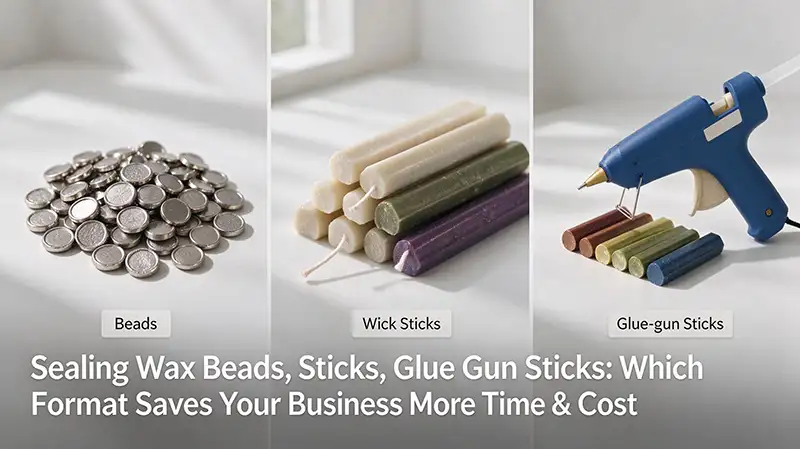
Short answer: beads are the cheapest per seal, glue-gun sticks are the fastest per seal, and wick sticks are the only format that needs no equipment at all. If you seal fewer than about 150 pieces per run, wick sticks win on total time. Between 150 and 1,500 pieces, beads plus a melting furnace give you the lowest unit cost. Above 1,500 pieces per run — or anywhere flame is not allowed — glue-gun sticks pull ahead because labor, not wax, becomes the dominant cost.
This guide breaks the three formats down on the numbers that actually decide it: seconds per seal, cost per 1,000 seals, break-even points and the hidden failure costs nobody quotes for. All figures are worked examples at indicative wholesale prices — substitute your own quote and the model still holds.
The Three Formats, in Plain Terms
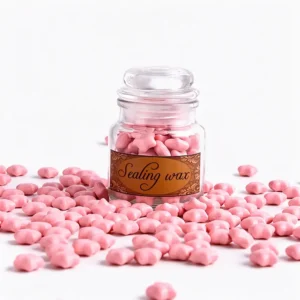
Sealing wax beads (pellets / granules)
Small granules, typically 2-3 mm, melted in a wax furnace or a melting spoon and poured onto the envelope before stamping. Because you control the scoop, beads give you the tightest control over wax volume per seal and the easiest route to custom color — mix two colors in the pot and you get a marbled seal that no pre-made stick can reproduce. Our 24-color sealing wax bead set is the retail-facing version of this format; bulk beads are supplied by weight.
Wick sealing wax sticks
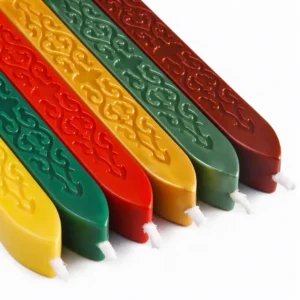
A rigid stick with a wick running through it. You light the end, let it drip onto the paper and stamp. Two shapes are standard: a 9 cm stick with a built-in wick for hand use (built-in wick sealing wax stick, 1.1 × 1 × 9 cm, 20 g) and a 14 cm round bar used with a spoon or furnace (round sealing wax stick, 1.1 × 1.1 × 14 cm, 20 g). No equipment, no warm-up, works on a table at a wedding fair.
Glue-gun sealing wax sticks
Low-melt wax rods sized for a standard 11 mm glue gun (7 mm mini guns use the thinner rod). The gun melts the rod on demand and dispenses a fixed bead of wax in one squeeze. No open flame, no pot, no spoon — which is why invitation studios and packaging lines use it. We formulate this wax to run at low temperature so it does not scorch or smoke the way a hardware-store glue stick would.
Time per Seal: Where the Minutes Actually Go
Per-seal time is not the melting time — it is setup plus dispensing plus stamping plus releasing. That is why the format that looks slowest on paper often wins small runs.
| Format | Setup (per session) | Dispense per seal | Stamp + release | Total per seal | 1,000 seals |
|---|---|---|---|---|---|
| Beads + furnace | 6-8 min to melt a batch | 8-10 s pour | ~4 s | ~12 s | ~3.3 h |
| Wick stick | ~10 s (light the wick) | 18-22 s drip | ~4 s | ~25 s | ~6.9 h |
| Glue gun | 3-5 min heat-up | 6-7 s squeeze | ~4 s | ~10 s | ~2.8 h |
Two practical notes on this table. First, the wick-stick figure assumes one seal at a time with the stick in hand; batching three or four envelopes in a row and rotating the stick between them cuts it to roughly 15 seconds, still the slowest of the three. Second, the glue-gun advantage compounds on a production line: the gun stays hot all shift, so the 3-5 minute heat-up is paid once, not once per run.
Cost per 1,000 Seals: Wax, Equipment and Labor
Model assumptions: a 25 mm round seal using about 2.5 g of wax, wax prices at indicative wholesale ranges, labor at $18/hour fully loaded, and equipment amortized over 50,000 seals. Change any input and the ranking stays the same — only the crossover point moves.
| Cost line | Beads + furnace | Wick sticks | Glue gun |
|---|---|---|---|
| Wax consumed | 2.5 kg | ~125 sticks (20 g each, ~8 seals per stick) | ~286 rods (11 mm × 100 mm) |
| Wax cost | $35 | $52 | $86 |
| Equipment (amortized) | $0.80 | $0 | $0.50 |
| Labor at ~1,000 pcs | $60 (3.3 h) | $124 (6.9 h) | $50 (2.8 h) |
| Total per 1,000 | ~$96 | ~$177 | ~$137 |
| Cost per seal | ~$0.10 | ~$0.18 | ~$0.14 |
| Hours per 1,000 | 3.3 | 6.9 | 2.8 |
Indicative numbers for comparison only — your quoted wax price, labor rate and seal size will move every line. The structure of the model is what matters: wax is the smallest cost in two of the three formats.
Read the table this way: at 1,000 seals, the wick stick costs $81 more than beads, and $40 more than the glue gun, almost entirely because of the 25 seconds per seal. Wax is never the problem. Labor is.
Break-Even: When Equipment Pays for Itself
Beads vs. wick sticks. A furnace plus a spare spoon runs roughly $40-60. At a saving of about $80 per 1,000 seals, the equipment pays back in under 600 seals — one moderate wedding order. After that, every seal is cheaper.
Glue gun vs. wick sticks. A low-temperature gun costs $20-30. Saving $40 in wax and roughly four hours of labor per 1,000 seals, it pays back in about 700 seals, faster if your labor rate is above $18/hour.
Beads vs. glue gun. Beads are cheaper per unit by about $0.04, but slower by about 30 minutes per 1,000 seals. At $18/hour that half hour is worth $9 — which is less than the $40 wax gap. So at 1,000 pieces beads still win; the glue gun overtakes only when your labor rate climbs or the run gets long enough that the time difference outweighs the wax difference.
Where equipment loses: at 50 seals, beads need 8 minutes of melting before the first seal exists. Wick sticks need ten seconds. For a one-off batch of 20-50 pieces, the $40 furnace is a genuine waste of money.
Batch-Size Playbook
Handcraft and small-batch studios (50-500 seals per month)
Start with wick sticks. No capital, no warm-up, no pot to clean, and you can keep six colors on the shelf without tying up money in equipment. Move to beads when you notice you are making more than about 150 seals in a single sitting — that is the point where the melting time stops being a rounding error and the per-seal saving starts to compound. Keep a mini glue gun for rush jobs of 100 or more.
Wedding orders (500-3,000 seals per event)
Wedding work has two constraints at once: color accuracy and deadline. Beads give you the color — a custom hue mixed in the pot matches the invitation suite, and you can adjust the marbling per batch. Run production on a furnace with two spoons so one is always molten. If the order repeats (a stationery brand doing the same seal every month), convert the approved color into glue-gun rods at MOQ 500 and cut the per-seal time roughly in half. That conversion is the single highest-leverage move in this category.
Factory and packaging lines (10,000+ seals per month)
Standardize one color per SKU, order glue-gun rods in that color, and keep a second gun hot as backup. Flame-free operation matters on a packaging line — no open wick, no soot near light-colored boxes, no fire permit issue. Labor dominates at this volume, so measure seconds per seal, not cents per gram. Buy rods on the same purchase order as your other packaging consumables to consolidate freight; sealing wax is light, and the freight cost per 1,000 seals drops sharply when it shares a container.
Four Hidden Costs That Decide the Format
- Crack rate after cooling. Brittle wax cracks when the stamp is released too cold or the seal is dropped in transit. Flexible low-temperature formulations cut rework sharply — ask for the flex grade, not just the color.
- Color consistency between batches. Beads are mixed by weight, so a Pantone match holds batch to batch. Pre-colored sticks can drift between production lots; if color is contractual, lock a master sample.
- Soot and residue. Wick sticks leave carbon on the spoon and occasionally on pale envelopes. On white stationery, one smudge costs more than the whole per-seal saving.
- Summer storage. Sticks soften and bend above roughly 35 °C in a warehouse or a delivery van; beads do not deform. If your stock sits in a non-climate-controlled space, beads are the safer inventory.
What We Supply
TaBo is a 14-year candle and craft-accessory manufacturer with a 20,000 m² facility, BSCI and ISO9001 certification, supplying sealing wax to stationery distributors, wedding-goods wholesalers and packaging converters in 40+ countries. The full range sits in our sealing wax and kits category — wax seal sticks, beads, warmers and furnaces and complete gift sets.
- Formats: beads by weight, wick sticks (9 cm and 14 cm), glue-gun rods, complete kits
- Colors: standard range plus custom color matching; metallic and marbled effects
- MOQ: 500 pieces per design; mixed-color trial orders accepted
- Samples: free pre-production samples, courier cost collect — see our sample policy
- Packaging: gift box, colored box, white box, brown box, PVC box or bespoke retail packaging
Not sure which format fits your line? Send us your monthly volume, seal diameter and labor rate — we will cost all three against your numbers and recommend one.
FAQ
-
How many seals does 1 kg of sealing wax beads make?
Roughly 350-400 seals at 2.5 g per 25 mm seal, allowing for pour waste. Smaller 20 mm seals stretch that to about 450; larger 30 mm seals drop it to about 280. Beads are sold by weight, so the yield is predictable once you fix seal size.
-
Can I melt sealing wax beads in a glue gun?
Not in a standard gun — the feed mechanism needs a solid rod. Some granule waxes can run through a dedicated melting nozzle or a wax pot with a dispensing tip, but a normal glue gun will jam. If you want gun speed, order the wax in rod format.
-
Which format is cheapest for 1,000 seals?
Beads plus a furnace, at roughly $0.10 per seal in our worked example — about 45% cheaper than wick sticks and 30% cheaper than glue-gun rods. The gap comes from labor time, not wax price.
-
Are wick sticks fast enough for a production line?
No. At roughly 25 seconds per seal including stamping, 1,000 seals takes close to seven hours, and the open flame is usually not permitted on a packaging line. Wick sticks are a retail and small-batch format.
-
What is the MOQ for custom colors?
500 pieces per design for sticks and rods, or 5 kg for loose beads. Color matching against a Pantone reference is included; we send a pressed sample seal for approval before the production run.
-
Can glue-gun seals match the look of traditional wax seals?
Yes. The same brass stamp is used, and low-temperature formula wax holds detail well. The difference is in hand feel: gun wax sets slightly faster and firmer, so release the stamp after about three seconds rather than five.